
Digital Transformation in Indian Higher Education After NEP 2020: Impact, Benefits & Challenges
Explore digital transformation in Indian higher education after NEP 2020—key initiatives, student benefits, challenges, and the future of EdTech in India.The National Education Policy (NEP) 2020 marked a decisive shift toward a technology-driven higher education ecosystem in India. The Government of India has launched multiple digital initiatives to improve access, transparency, flexibility, and quality. These initiatives are rooted in the vision of creating a Digital Education Ecosystem that is scalable, inclusive, and future-ready.
Key Digital Initiatives in Higher Education (Post-NEP 2020)
| Initiative | Main Focus | Core Area |
|---|---|---|
| SWAYAM | Online courses (MOOCs), credit transfer | Teaching–Learning |
| SWAYAM Plus | Industry-linked courses, upskilling | Employability & Skills |
| Academic Bank of Credits (ABC) | Credit storage, transfer, mobility | Academic Flexibility |
| National Academic Depository (NAD) | Digital certificates verification | Governance & Authentication |
| SAMARTH ERP | Digital administration (admission to degree) | Institutional Management |
| National Digital Library of India (NDLI) | Access to digital learning resources | Knowledge Access |
| Virtual Labs | Remote experimentation | Practical Learning |
| e-Yantra / FOSSEE / Spoken Tutorial | Skill development in engineering & IT | Technical Education |
| SATHEE Platform | Entrance exam preparation support | Student Support |
| National Educational Technology Forum (NETF) | Policy guidance on EdTech | Governance & Innovation |
| Digital University (proposed) | Integrated digital higher education ecosystem | System Integration |
| APAAR ID (Academic Identity) | Unique student digital ID | Student Lifecycle Management |
These initiatives collectively aim to digitise the entire student lifecycle—from admission to certification—ensuring efficiency and transparency.
Impact, Progress, Challenges, and Future Path of Digital Initiatives in Indian Higher Education
India’s higher education system is undergoing a profound transformation driven by digital initiatives introduced after the National Education Policy (NEP) 2020. These reforms aim not merely to digitise existing processes but to reimagine education as flexible, accessible, and learner-centric. While significant progress has been made, the journey reveals both achievements and structural gaps that need urgent attention.
1. Impact on Students: Access, Flexibility, and Empowerment
One of the most visible impacts of digital initiatives is the democratisation of access to education. Platforms like SWAYAM have enabled millions of learners to access high-quality courses from premier institutions regardless of geographical location. With over 5 crore enrollments and thousands of courses, SWAYAM has become a cornerstone of India’s digital learning ecosystem.
The Academic Bank of Credits (ABC) has introduced unprecedented flexibility. Students can now accumulate credits across institutions and redeem them toward degrees, enabling multiple entry and exit options—a major structural reform envisioned by NEP 2020.
Similarly, digital repositories like the National Academic Depository (NAD) ensure that students no longer need to worry about losing certificates or facing verification delays. These systems also reduce fraud and enhance the credibility of qualifications.
In addition, platforms such as SWAYAM Plus and SATHEE are bridging the gap between academia and industry, helping students gain market-relevant skills and prepare for competitive examinations.
2. Impact on Institutions: Efficiency and Transparency
For higher education institutions (HEIs), digital initiatives have significantly improved administrative efficiency. The SAMARTH ERP system, for instance, integrates the entire academic lifecycle—from admissions to degree issuance—into a single digital platform.
This has reduced bureaucratic delays, improved record-keeping, and enhanced transparency in governance. Institutions are increasingly able to track student progress, manage data effectively, and streamline operations.
Moreover, digital tools have enabled universities to expand their reach through online and open distance learning (ODL) programs. As per government data, hundreds of universities now offer thousands of online and ODL courses, reflecting a shift toward blended and flexible learning models.
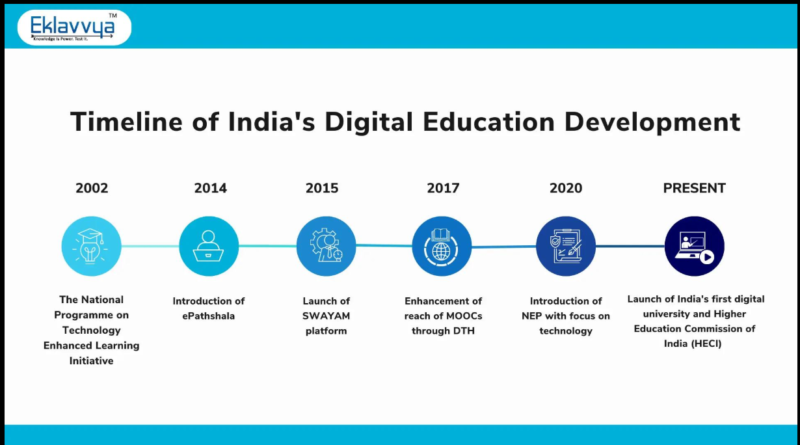
3. Progress Over Time: From Access to Ecosystem Building
The evolution of digital initiatives in India can be seen in three phases:
- Pre-NEP Phase: Focus on content creation (NDLI, Virtual Labs, SWAYAM)
- Immediate Post-NEP Phase: Expansion and integration (ABC, NAD, SAMARTH)
- Current Phase: Ecosystem development (SWAYAM Plus, Digital University, AI integration)
This progression reflects a shift from isolated platforms to an integrated digital ecosystem. The idea is to create a seamless experience where student identity, credits, learning resources, and certifications are interconnected.
The introduction of APAAR ID further strengthens this vision by providing a unique digital identity for students, enabling lifelong academic tracking.
4. Key Benefits: A Paradigm Shift
The cumulative impact of these initiatives can be summarised in four key transformations:
- Flexibility: Students can learn at their own pace and across institutions
- Accessibility: Education reaches remote and underserved regions
- Transparency: Digital records reduce corruption and inefficiency
- Scalability: Technology enables large-scale delivery of quality education
These changes align with India’s ambition to increase the Gross Enrolment Ratio (GER) in higher education to 50% by 2035.
5. Persistent Gaps and Challenges
Despite these achievements, several challenges remain:
a) Digital Divide
Access to devices, internet connectivity, and digital literacy remains uneven. Rural and economically weaker sections often struggle to benefit from digital platforms.
b) Trust Deficit
Digitisation has not fully addressed issues of credibility and quality assurance, particularly in online assessments and certifications.
c) Fragmentation
Many platforms operate in silos, limiting interoperability. The absence of a fully integrated system reduces efficiency.
d) Faculty Readiness
Teachers often lack adequate training to effectively use digital tools, leading to suboptimal implementation.
e) Data Privacy Concerns
Large-scale data collection raises concerns about security, misuse, and ethical governance.
6. Insights from Research and Policy Studies
Studies on MOOCs and digital education highlight that technology alone cannot ensure learning outcomes. Effective pedagogy, learner engagement, and assessment design are equally important.
Similarly, research on digital repositories like NAD shows that while they improve efficiency, they must address challenges related to standardisation and institutional diversity.
Government reports also emphasize the need for a public digital infrastructure that is interoperable, inclusive, and adaptable to technological changes. (DSEL Education)
7. The Future Path Forward
To fully realise the potential of digital initiatives, India must focus on the following strategies:
a) Integration of Platforms
Creating a unified digital ecosystem where ABC, NAD, APAAR, and learning platforms are interconnected.
b) Strengthening Digital Infrastructure
Expanding broadband connectivity (e.g., BharatNet) and ensuring device access for all students.
c) Capacity Building
Training faculty and administrators in digital pedagogy and technology use.
d) Enhancing Trust
Improving assessment transparency, introducing blockchain-based certification, and ensuring data security.
e) Leveraging AI and Analytics
Using artificial intelligence for personalised learning, predictive analytics, and academic planning.
f) Policy and Regulation
Establishing clear guidelines for EdTech, data privacy, and ethical AI use through bodies like NETF.
8. Conclusion
The digital transformation of Indian higher education is one of the most ambitious reforms in recent decades. Initiatives such as SWAYAM, ABC, NAD, and SAMARTH have laid the foundation for a flexible, transparent, and scalable education system.
However, the journey is far from complete. The real challenge lies not in adopting technology but in building trust, ensuring equity, and integrating systems effectively.
If these challenges are addressed, India has the potential to emerge as a global leader in digital higher education, creating a model that balances scale with quality and innovation with inclusivity.