

The Absorbent Mind: A Journey Through Maria Montessori’s Vision for the “Forgotten Citizen”
Explore Maria Montessori’s revolutionary concept of the "absorbent mind," a natural, sponge-like capacity for children to learn effortlessly from birth to age six. Discover why her insights on sensitive periods and the prepared environment—refined during her transformative years in India—remain essential for modern parents and teachers seeking to unlock a child's full potential.In the early 1900s, in the San Lorenzo district of Rome, a young doctor named Maria Montessori walked into a room of children that society had largely given up on. These were the children of low-income, working parents, left unsupervised while their families labored. Montessori, one of the first women to graduate from medical school in Italy, did not see “unruly” students; she saw a mystery of nature waiting to be unlocked. This encounter was the spark that eventually led to her seminal work, The Absorbent Mind. This book remains a beacon for anyone seeking to understand the profound potential of early childhood.
The Pioneer Who Listened
Maria Montessori was never one to follow the expected path. At an early age, she enrolled in an all-boys technical school with the goal of becoming an engineer. When she shifted her focus to medicine, she was met with hostility from male students and was even forced to perform her dissections of cadavers alone, after hours, because it was considered inappropriate for a woman to be in the presence of men and a naked body.
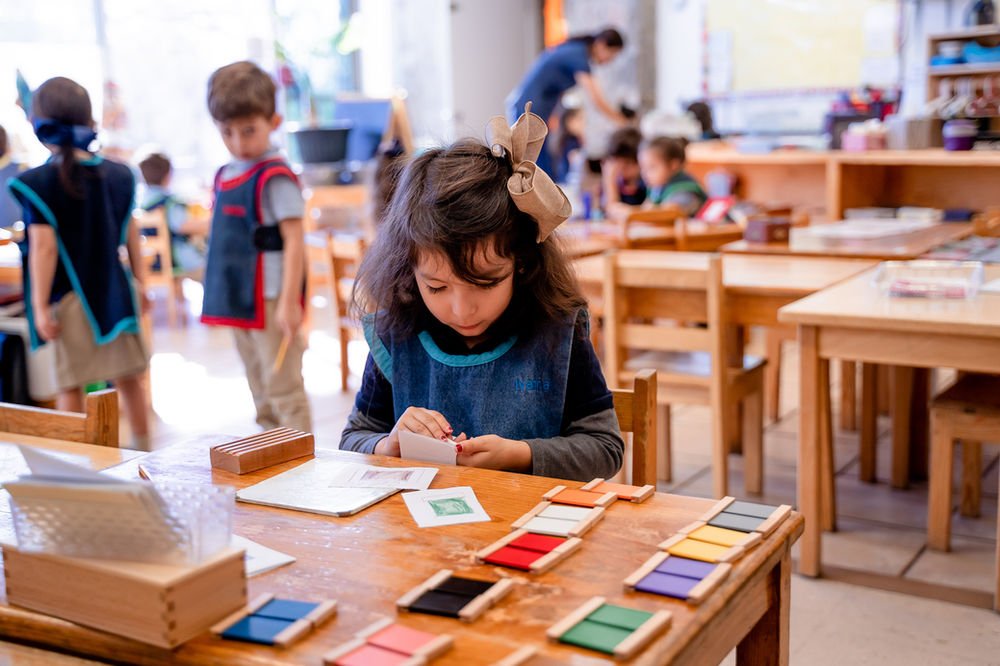
Despite these hurdles, her scientific training as a physician became her greatest tool. In her first Casa dei Bambini (Children’s House), she observed children displaying deep attention, spontaneous repetition, and a natural sensitivity to order. One particularly telling insight occurred when she offered the children expensive toys; she found they ignored them in favor of “practical life” activities like sweeping, dusting, and flower arranging. She realized that children possess an innate, natural drive to learn through meaningful work rather than passive entertainment.
A Masterpiece Born in the Heart of India
While her work began in Rome, The Absorbent Mind was actually forged during a period of forced stillness in India. In 1939, Montessori was invited to India by the Theosophical Society to give a training course. However, when Italy entered World War II in 1940, she and her son, Mario, were interned as “enemy aliens.”
Instead of halting her work, these years in India (1939–1946) became some of her most productive. She lectured extensively in places like Ahmedabad and Adyar, observing children of different cultures and refining her theories on human development. It was from the notes taken by her students during these Indian courses that the first English edition of The Absorbent Mind was eventually published in 1949. During this time, she also developed “cosmic education,” an approach for older children that emphasizes the interdependence of all elements in the natural world. Tagore was one of the early sponsors of the Association Montessori Internationale (AMI), which was founded by Montessori and her son, Mario, in 1929. By 1929, Tagore had already founded many “Tagore-Montessori” schools in India.
The Central Idea: A Mind Like a Sponge
The core of Montessori’s book is the concept of the “absorbent mind.” She describes the child’s brain as a physical entity with a sponge-like capacity to absorb knowledge from the world effortlessly. Unlike an adult, who must consciously strive to learn a new language or skill, a young child simply is the environment they inhabit.
Montessori identifies two critical phases within this period:
- The Unconscious Phase (0–3 years): The child is a sensory explorer, absorbing language, culture, and habits without any conscious effort.
- The Conscious Phase (3–6 years): The child begins to purposefully seek out experiences, refining their skills through hands-on activities and developing a more structured, analytical way of thinking.
The “Dance” of Sensitive Periods
A vital addition to the theory of the absorbent mind is the concept of “sensitive periods.” Montessori describes these as distinct intervals during which a child is exceptionally receptive to acquiring a particular capability—such as language, order, or sensory perception.
She viewed these periods as direct manifestations of the absorbent mind. When a child is in a sensitive period for language, for instance, they pick up words and syntax with a speed that will never be replicated again in their life. If the environment does not provide the necessary stimulation during these “windows of opportunity,” the child must later acquire these skills through much harder, conscious labor.
Why It Matters Today
In a modern world where we often feel pressured to “hustle” children into early academic success, Montessori’s message is a refreshing call to trust the child’s natural development. Her insistence that the environment shapes the child is echoed in contemporary educational frameworks that prioritize foundational learning.

For teachers, the book is a guide to becoming an “observer” rather than a “lecturer.” It challenges us to prepare an environment where children can reach autonomy through independent work. For parents, it offers a perspective shift: a toddler’s “messy” play is actually the construction of a human being. Montessori famously called the child the “neglected citizen,” a person without rights whose soul is often suffocated by adult rules.
Key Insight: The Long-Term Impact
The most profound takeaway from the book is that “what a child experiences becomes who they are.” Montessori believed that if a child is raised in an environment of order, beauty, and respect, they will develop “spontaneous discipline” and a love for learning. She viewed education as the only true means to eliminate war, stating, “Establishing lasting peace is the work of education; all politics can do is keep us out of war.”
Reflections
As we reflect on these concepts, consider how we might change our approach:
- In the Classroom: Are we providing enough freedom for self-directed discovery, or are we “crucifying children on school benches” with rigid rules?
- At Home: Can we involve children more in “practical life”? Simple tasks like cooking, gardening, or cleaning not only build motor skills but also foster independence and self-confidence.
Conclusion
Maria Montessori’s work reminds us that the early years are not a preparation for life; they are life. The “absorbent mind” is a fleeting, precious power that allows a child to build their own personality and intelligence from the world around them.
As you close the pages of this classic, one question remains to carry into your daily life: If the environment truly shapes the child, what kind of world are you preparing for the absorbent minds in your care?