
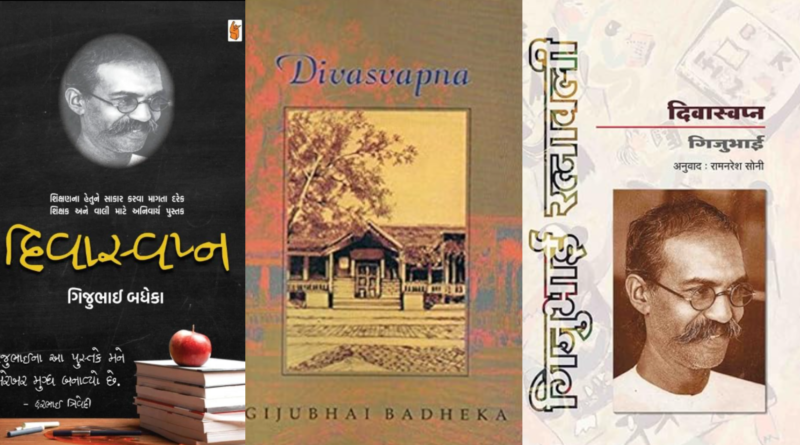
The Daydream that Awakened the Classroom: A Journey through Gijubhai Badheka’s Divaswapna (दिवास्वप्न)
Imagine, for a moment, a man standing in a courtroom in western India during the early 20th century. He is a successful High Court pleader, a man of logic, law, and respectable standing. But in 1913, something happens that shifts the trajectory of his life forever: his son is born. As he holds the newborn, he isn’t just filled with fatherly joy; he is gripped by a sudden, sharp anxiety. He remembers his own childhood—a “land of small terrors” where the school bell signaled the start of a day defined by the cane and the monotonous drone of rote memorization. He looks at his son and asks a question that would eventually revolutionize Indian education: “Wasn’t there a way out? Couldn’t there be a better way to teach and learn?”
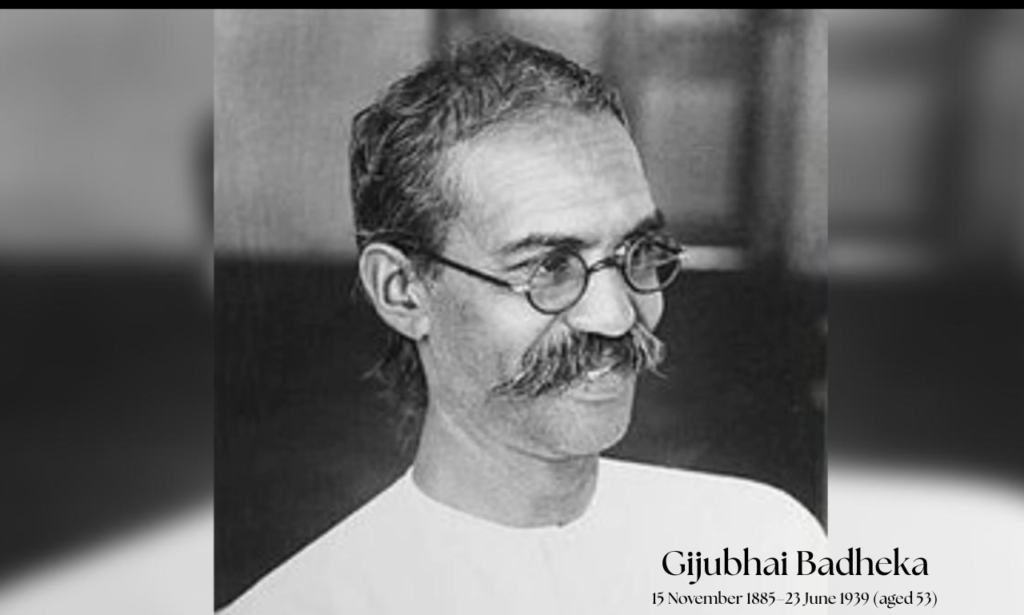
This man was Gijubhai Badheka, affectionately known by Mahatma Gandhi and generations of children as “Moochhali Maa”—the “Mother with Whiskers”. Driven by a dissatisfaction with the soul-crushing traditional schooling of his era, Gijubhai abandoned his legal practice in 1916 to join the Dakshinamurti institution, eventually founding the “Bal Mandir” pre-primary school in 1920. He didn’t just want to teach; he wanted to reform the very soul of the classroom, moving away from “teachers who only knew how to teach through fear”.
His greatest legacy to this vision is the book Divaswapna (“Daydreams”), first published in Gujarati in 1932. It is a book that every teacher and parent should keep on their bedside table, not as a dry manual, but as a source of radical hope.
The Story of a Rebel Teacher
Divaswapna is a unique literary creation. It is presented as an autobiographical narration. It is best understood as a semi-fictional or experiential narrative. Gijubhai Badheka presents the story in a narrative form—with a teacher, a classroom, and events that feel like fiction—but the ideas and incidents are deeply rooted in his real-life experiments with children. A teacher named Laxmiram, who rejects the orthodox, dust-wrapped culture of colonial-era primary schools. While the narrative is fictionalized, it is deeply experiential, rooted in Gijubhai’s own radical experiments with Montessori methods adapted for the Indian context.
The book is structured into four parts: the beginning of the experiment, its progress, the year-end results, and a final gathering of teachers. From the very first page, we meet Laxmiram as he approaches an Education Officer, pleading for a single primary school class to test his theories. The officer laughs, warning him that “teaching children… is no joke. It is an uphill task”. Laxmiram is undeterred. He accepts a class of Standard Four students, a syllabus he finds lacking, and a set of textbooks he plans to largely ignore. Thus begins a year-long journey that feels like a conversation between the author and the reader, inviting us to witness the messy, beautiful reality of a classroom coming to life.
Freedom, Love, and the Natural Child
At the heart of Gijubhai’s philosophy is a profound respect for the natural curiosity of children. He believed that the child already possesses the “hidden and inborn developmental powers” needed to learn; the adult’s role is merely to be a facilitator. In the sources, we see Gijubhai’s unwavering belief that freedom and love are the twin principles of education.
He critiques the traditional school culture that treats children as empty vessels to be filled with textbook facts for the sole purpose of passing examinations. To Gijubhai, a teacher who uses fear is a failure. Instead, he advocates for the “play-way” method, where music, dance, travel, and storytelling replace the rod. He argues that if children are treated with respect and given meaningful opportunities to explore, they won’t abhor school—they will look forward to it as a place of adventure.
Memorable Moments from the Classroom
The magic of Divaswapna lies in its vivid, often humorous, classroom incidents. Consider Laxmiram’s disastrous first day. Armed with grand ideas about “The Game of Silence” from Montessori theory, he tells his boisterous students to be quiet and darkens the room. Instead of a meditative hush, the boys start making catcalls, humming, stamping their feet, and clapping. Laxmiram is abashed and turns pale; his “notes” prove impracticable because he hasn’t yet established a rapport with the children.
However, he doesn’t give up. The next day, he tries a different “magic pill”: storytelling. He begins a tale about a king with seven queens and princesses with palaces made of pearls. The effect is instantaneous. The headmaster walks in to find the class in “absolute silence,” listening with “rapt attention”. Through this, Laxmiram realizes that the story is the gateway to the child’s heart.
Another striking incident involves teaching geography. Instead of making students memorize lists of rivers and mountains from a map—a practice Laxmiram finds “ridiculous”—he creates a game called “Let us Travel.” They imagine journeys to Ahmedabad or England, planning which trains to take, estimating expenses, and researching what is worth seeing in each town. They visit local markets to see where goods come from, turning the world itself into their textbook.
Later in the book, during the terminal examinations, Laxmiram refuses to subject his students to the standard stress. Instead, he draws a curtain and reveals his students engaged in storytelling for other classes, playing games of Antakadi with poetry, and demonstrating a “museum” of items they collected themselves during hikes, including terracotta toys they baked on the riverbank. It is a stunning display of engagement over examination.
Voices of Wisdom: Quotes from the Source
Gijubhai’s words carry a weight that remains undiminished by time. Let’s look at a few:
- “The story is a wonderful magic pill that helps to establish rapport between the pupils and the teachers.”.
- Significance: This quote emphasizes that education must begin with an emotional connection. Before a child can learn a fact, they must trust and love the person teaching them.
- “Games are real education. Great powers are born on the playground. Games mean character-building.”
- Significance: Gijubhai challenged the idea that the playground was a waste of time. He saw it as the primary site for learning social rules, resilience, and ethics.
- “Religion is an awakening, and it comes from within… This untimely introduction to religion is like an untimely married life.”
- Significance: In a beautiful debate with a visiting monk, Laxmiram argues against forcing rituals or dogmas on children. True moral education comes from living a life of truth and observing the spirit of saints, not from memorizing verses the child cannot understand.
- “One must have enthusiasm, self-confidence, and unswerving dedication to the cause… The main thing is the intuition to innovate.”
- Significance: This is Gijubhai’s call to action for teachers. He argues that resources and language skills are secondary to the teacher’s “yearning of one’s soul” to do right by the child.
Why the Daydream Still Matters
Decades after its publication, Divaswapna feels remarkably contemporary. Many of the ideas championed by Laxmiram—experiential learning, a child-centered approach, and the integration of the arts and stories—are exactly what modern policies, such as India’s NEP 2020, aim to achieve.
The book remains a scathing critique of our current obsession with rote learning and exam pressure. We still live in a world where children are often “imprisoned” in colorless schools, their natural curiosity suppressed by the “useless burden” of rigid syllabi. For policy thinkers, Divaswapna is a reminder that reform must happen in the heart of the classroom, not just on paper. For parents, it is a plea to prioritize their child’s joy and “emotional connection” over ranks and results.
Key Insights for Every Educator
The major takeaway from Gijubhai is that children learn best when they are respected. When Laxmiram introduces a classroom library, he allows the children to pick the books they want to read, even if they make a noise reading aloud at first. He understands that “new habits are to be infused in society and this called for repeated efforts.”
He shows us that the environment shapes learning. By bringing mirrors and combs to school and leading a “broom drill,” Laxmiram teaches personal hygiene and order not as a chore, but as a point of pride. He demonstrates that “games and stories are… half their education” because they provide an “outlet for restlessness” that traditional classrooms try to beat into submission.
Reflections for the Modern Home and School
If you are a teacher, Divaswapna asks you: Could you, for just one week, put away the textbook and tell a story instead? Could you replace a test with a “travel” game? Gijubhai challenges us to stop “cheating” our superiors by presenting a veneer of memorized success and instead show the “real state of things”.
If you are a parent, the book nudges you to rethink upbringing. Are we, like the parents in the book, telling our teachers to “just teach” and ignore the child’s character or cleanliness?. Gijubhai suggests that “God helps only those who help themselves,” and that includes taking an active, joyous role in a child’s natural development.
A Part of Every Educator’s List
Gijubhai Badheka ends Divaswapna on a note of triumph. At the final prize distribution, the education officer—once a skeptic—announces that instead of giving individual prizes that breed “false pride,” the money will be used to build a school library. He admits that Laxmiram “changed my ideas” and that the old generation must “yield place to imaginative educationists.”
A Living Classic for Every Educator
Divaswapna is not just a book to read—it is a book to live. It offers no ready-made answers, yet it quietly transforms how we see children, classrooms, and the purpose of education. Once that shift happens, teaching and parenting cannot remain the same.
In an age of marks and competition, Gijubhai Badheka reminds us:
“The child is the center of education—not the system.”
First published in 1931 in Gujarati, the book emerged from real classroom experiments. Its powerful vision led to translations into Hindi (1950s–60s)and English (1960s–70s), helping spread child-centered education across India. Institutions like the National Book Trust and Eklavya Foundation continue to publish accessible editions.
The book is easily available on Amazon, and digital versions offer a comfortable reading experience with clear formatting.
Nearly a century later, its relevance endures. As you finish reading, one question lingers:
If we truly trusted children, how different would our schools—and society—be?
Divaswapna is more than a book review; it is a manifesto for the soul. It leaves us with a hauntingly beautiful question: Are we brave enough to daydream for our children? As you finish this book, you are left with the image of children who are “orderly, healthy, and cheerful”—not because they were forced to be, but because they were finally allowed to be themselves. For anyone who believes that a classroom should be a place of “joy and curiosity,” this classic is not just a suggested read—it is essential.