
Do We Really Need Schools? Rethinking Education with Ivan Illich
Exploring Deschooling Society—a bold vision where learning breaks free from institutions and returns to curiosity, community, and human connection. Dismantling the myth that schooling equals education to reclaim human agency through decentralized learning webs.
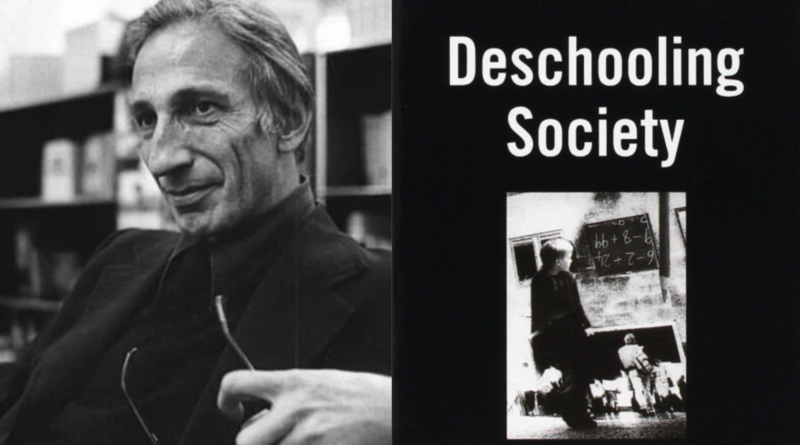
Ivan Illich was far more than an educational theorist; he was a wandering “Christian pilgrim,” a polyglot who spoke eight languages, and a radical social critic who saw modern institutions as the “secular religions” of an industrial age. Before publishing his most famous work, Illich was an Austrian priest who studied crystallography, history, and theology before establishing the Center for Intercultural Documentation (CIDOC) in Mexico. His life was defined by a rejection of the “engineered messiah”—the bureaucratic systems of transportation, medicine, and schooling that he believed had exceeded a human scale and created patterns of dependency rather than empowerment.
His 1971 book, Deschooling Society, arrived at the height of an era defined by institutional critique. It was not a plea for reform but a “thoroughgoing condemnation” of the school as a total institution. Illich challenged the very bedrock of modern life, questioning why we had allowed a state-controlled monopoly to define what it means to be an educated human being. He wrote in a style that was often scriptural and prophetic, reflecting his conviction that deschooling was “the root of any movement for human liberation”.
The central idea of the book is as simple as it is jarring: schooling is not the same as education. Illich argues that most learning occurs incidentally—outside of school—through friendship, love, television, or the simple challenge of a street encounter. Yet, the institutionalization of learning has created a “hidden curriculum” that teaches children to value institutional commodities above their own curiosity or the help of a neighbor. In this system, children are taught that learning happens only under the supervision of a certified professional and within the confines of a classroom.
One of Illich’s most powerful insights is that learning can exist without institutions. He famously argued that schools are “advertising agencies” for a consumer society, making students believe that their value is determined by the “pyramid of classified packages” they have consumed in the form of curriculum. This creates a “myth of institutionalized values” where a diploma is mistaken for competence and a grade for actual insight. He believed that this system of mandatory attendance and certification served primarily as a tool for social control and exclusion, ensuring that the poor would always be judged—and judge themselves—by their lack of formal credentials.
To replace these “scholastic funnels,” Illich proposed the concept of “Learning Webs”. He envisioned four decentralized networks that would facilitate self-directed learning: Reference Services to Educational Objects (public access to tools and labs), Skill Exchanges (directories of people willing to model expertise), Peer-Matching (finding partners for common inquiry), and Reference Services to Educators-at-Large (independent professional guides). He believed that an ideal educational system should simply provide access to resources and people “at any time in their lives”. It is remarkable that Illich anticipated the power of modern technology to support such a vision long before the birth of the internet, arguing that computers and telephones should be used to make free speech and assembly truly universal.
These ideas are more relevant today than ever before. In our digital age, online learning platforms like YouTube, MOOCs, and skill-based communities like Scratch function as primitive versions of Illich’s “webs,” allowing learners to bypass traditional gateways and follow their own interests. The global COVID-19 pandemic acted as a sudden, massive experiment in deschooling, as governments closed buildings and families were forced to navigate “uncharted learning landscapes”. This period revealed that schools serve “custodial” and economic functions—keeping children contained so parents can work—that are often conflated with their educational purpose.
However, a critical reflection on Illich’s work suggests that we must maintain a balanced view. While deschooling sounds liberating, the experience of “remote learning” during lockdown highlighted significant inequalities. Many families lack the cultural, social, or economic capital to act as their own educational coordinators, raising the risk that a fully deschooled society would favor the already advantaged. Furthermore, schools—for all their bureaucratic flaws—provide a vital space for sociability and socialization that technology cannot easily replace.
The enduring relevance of Illich’s ideas lies in his invitation to “retrace our steps” and question what schools are actually for. For teachers, Illich suggests a shift from being “custodians” of the classroom to becoming “pedagogical counselors” or intellectual leaders who invite disciples into their own research. For parents, the takeaway is to recognize and reclaim the educational potential of the community, rather than relying solely on institutional mandates. As Illich wrote, “universal education through schooling is not feasible,” but a world made “transparent by true communication webs” might be.
As we look toward flexible educational pathways and the future of digital learning, we must confront Illich’s challenge to our institutional imagination. If we are to avoid a “brave new world” of programmed instruction, we must seek educational structures that enhance human agency rather than suppressing it. Ultimately, the book forces us to confront a profound question about our own autonomy: “If learning is everywhere, do we still need schools as we know them?”.