
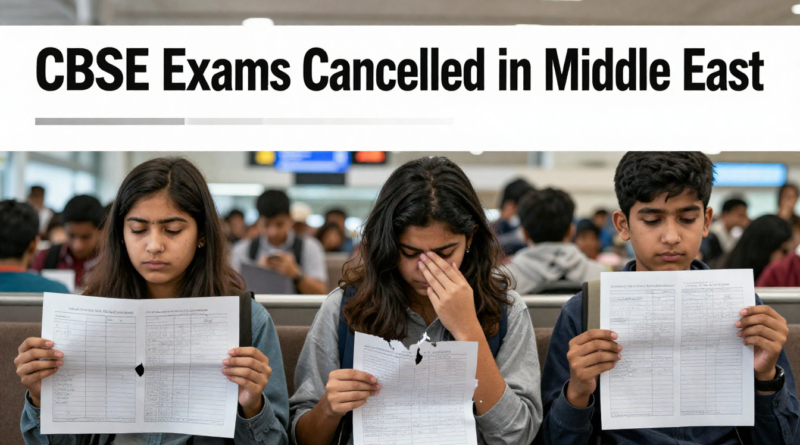
CBSE Cancels Class 10 and 12 Board Exams in the Middle East: Uncertainty for 50,000 Students Across Seven Countries
In a major development affecting Indian students studying abroad, the Central Board of Secondary Education (CBSE) has cancelled the Class 10 and Class 12 board examinations in several Middle East countries, impacting more than 50,000 students from over 150 CBSE-affiliated schools. The decision comes after weeks of uncertainty, multiple circulars, and rising concern among parents, teachers, and students in the region.
The cancellation has raised significant questions about how students will be evaluated, how universities will consider their results, and how the board plans to maintain academic fairness for candidates who were preparing for the examinations for months.
A Decision Triggered by Regional Uncertainty
The CBSE announced that all remaining Class 12 examinations scheduled between March 16 and April 10, 2026, in Middle East centres have been cancelled. The decision affects students studying in Bahrain, Iran, Kuwait, Oman, Qatar, Saudi Arabia, and the United Arab Emirates.Officials said the decision was taken after reviewing the security situation and logistical feasibility of conducting examinations in the region. Schools and authorities had reportedly requested the board to reconsider the schedule due to escalating geopolitical tensions and safety concerns.
Earlier in March, CBSE had already postponed several examinations, issuing a series of circulars as the situation evolved. However, as uncertainty continued, the board eventually decided that conducting the exams was no longer practical.
Over 150 Schools and 50,000 Students Affected
According to education reports, more than 150 CBSE-affiliated schools in the Middle East region are affected, with over 50,000 students preparing for the board examinations this year.
Many of these students are children of Indian expatriates working in Gulf countries. For them, CBSE board examinations serve as a crucial academic milestone, determining admission opportunities in universities in India and abroad.
For months, these students had been preparing for the high-stakes examinations. The sudden shift from postponement to cancellation has therefore created a wave of anxiety among families.
A Series of Circulars Created Confusion
One of the major reasons for the psychological stress among students has been the frequent circulars issued by CBSE during the past few weeks.
The board first postponed examinations scheduled between March 9 and March 11, citing the regional situation. Later notices extended the postponement to other exam dates, with CBSE stating that it would review the situation again before deciding the next steps. (Khaleej Times)
During this period, several fake notices also circulated on social media, further increasing confusion among students and parents. Authorities had to clarify that only official circulars should be trusted.
For many students, the uncertainty meant studying continuously without knowing whether the exams would actually take place.
Mental Stress Among Students
Education experts believe that the prolonged uncertainty created significant psychological stress for students preparing for their board examinations.
Board exams in India and Indian-curriculum schools abroad are considered extremely important. They often determine the academic path of students, especially for those applying to universities or competitive courses.
When exam schedules change repeatedly, students face a unique challenge. They must maintain their preparation level for an unknown date while managing anxiety about their future.
In the Middle East region, several parent associations had also appealed to authorities to take a clear and student-friendly decision, arguing that the prolonged uncertainty was affecting students’ mental health.
What Happens to Results Now?
The biggest question now is how the results of these students will be determined.
CBSE has said that the mode of evaluation and result declaration will be announced separately.
Experts expect that the board may adopt alternative assessment methods, similar to the approach used during the COVID-19 pandemic. In 2021, when board examinations in India were cancelled due to the health crisis, CBSE evaluated students using a combination of internal assessments, previous exam performance, and school records.
A similar formula may be considered this time, although the board has not yet confirmed the exact mechanism.
Universities and Admissions
Another important concern is university admissions. Students from CBSE schools in the Middle East often apply to universities in India, the United Kingdom, Canada, Australia, and other countries.
CBSE has assured schools and students that their certificates will hold the same academic value as those of students who complete the board examinations elsewhere.
Universities are expected to consider the extraordinary circumstances under which the exams were cancelled.
Lessons for Global Education Systems
The episode highlights how global political developments can affect education systems far beyond national borders.
Indian curriculum schools operate across dozens of countries, especially in regions with large Indian diaspora populations. When regional instability arises, conducting synchronized examinations becomes extremely challenging.
The situation also raises broader questions about whether traditional high-stakes board examinations should rely entirely on a single final test, or whether continuous assessment models may provide a more resilient system.
A Moment of Transition
For the thousands of students affected by this decision, the coming weeks will be crucial. They await clarity from CBSE regarding the evaluation formula and the timeline for result declaration.
While the cancellation may offer temporary relief from examination pressure, it also represents an unexpected turning point in their academic journey.
Education experts emphasize that clear communication from authorities and strong support from schools and families will be essential in helping students navigate this unusual situation.
As global education systems become increasingly interconnected, events like this remind us that academic planning must also be prepared for unexpected disruptions.