
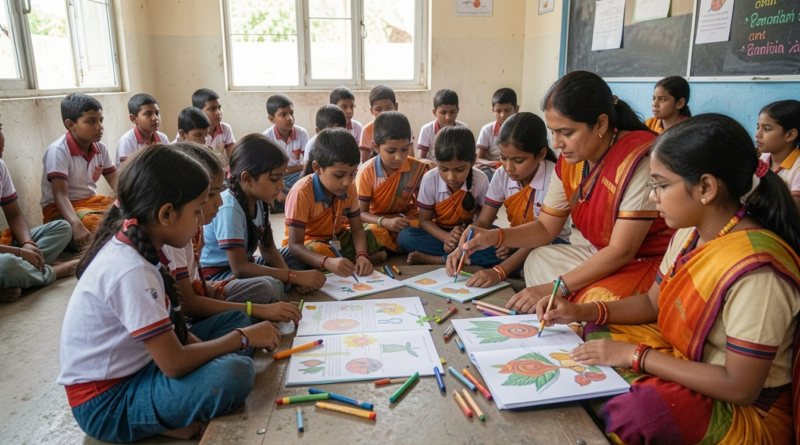
How a School in the Nilgiris is Redefining Education for Adivasi Children
A unique school system in the Nilgiris is transforming tribal education by using nature, culture, and experiential learning instead of textbooks. Discover how this model aligns with NEP 2020 and reshapes inclusive education in India.When the Forest Becomes a Classroom
In an era where education is increasingly standardized, one school in the Nilgiris of Tamil Nadu offers a radically different vision. At Vidyodaya School in Gudalur, learning is not confined to textbooks or classrooms. Instead, it emerges from forests, traditions, and everyday life.
This model is especially significant for Adivasi (tribal) children, who often feel disconnected from mainstream education systems. By integrating culture and environment into learning, the school has created a system that is both inclusive and deeply effective.
Why Conventional Education Often Fails Tribal Children
Across India, tribal communities face persistent educational challenges:
| Challenge | Impact |
|---|---|
| Language barriers | Difficulty in comprehension |
| Cultural disconnect | Loss of interest in schooling |
| Economic hardship | High dropout rates |
| Rote learning methods | Limited critical thinking |
Traditional schooling often ignores indigenous knowledge systems. As a result, children are expected to adapt to an unfamiliar framework rather than learning through what they already know.
The Vidyodaya Approach: Learning from Life
At Vidyodaya, education begins with the child’s environment.
- Mathematics is taught using seeds, stones, and daily activities
- Science emerges from observing forests, animals, and ecosystems
- Social studies is rooted in community traditions and practices
This experiential learning model ensures that concepts are not memorized but understood.
Instead of asking children to leave their world behind, the school brings their world into education.
Culture as Curriculum, Not Extra Activity
One of the most striking features of this school is its cultural integration.
Children learn through:
- Tribal songs and dances
- Folk stories and oral traditions
- Bamboo crafts and beadwork
- Indigenous food practices and forest knowledge
A locally developed “Food Book” documents traditional practices such as foraging and medicinal plant use, turning everyday knowledge into structured learning.
This approach builds self-respect, identity, and confidence among students.
Nature-Based Learning: The Forest as Teacher
At Vidyodaya, nature is not just a backdrop—it is a teacher.
Students regularly:
- Go on forest walks
- Identify plants and animals
- Learn ecological balance firsthand
- Use natural objects as learning tools
Leaves demonstrate symmetry, seeds teach counting, and ecosystems explain interdependence.
This method fosters curiosity, observation skills, and environmental awareness, which are essential for 21st-century learning.
Community Participation: Education Beyond School Walls
Another key strength of this model is community involvement.
- Parents actively participate in school activities
- Elders share traditional knowledge
- Many teachers belong to Adivasi communities
This creates a culturally sensitive and emotionally secure environment for children.
The school, run by the Viswa Bharati Vidyodaya Trust, also provides free education, addressing socio-economic barriers alongside academic ones.
Alignment with NEP 2020: A Real-World Example
India’s National Education Policy (NEP) 2020 emphasizes:
| NEP Principle | Vidyodaya Implementation |
|---|---|
| Experiential learning | Forest-based education |
| Mother tongue instruction | Local language teaching |
| Holistic development | Integration of culture and life skills |
| Inclusivity | Focus on marginalized tribal communities |
Vidyodaya is not just an alternative school—it is a living model of NEP 2020 in action.
Lessons for Educators and Policymakers
This model offers important insights:
- Education must be contextual, not one-size-fits-all
- Indigenous knowledge systems should be respected and integrated
- Learning should be experiential, not rote-based
- Schools must build identity, not erase it
For a diverse country like India, such approaches are not optional—they are essential.
Rethinking Education in India
The story of Vidyodaya School challenges a fundamental question:
Is education about completing textbooks or about understanding life?
By replacing rote learning with experience and alienation with belonging, this school in the Nilgiris shows that meaningful education is possible—especially for those who need it the most.
As India moves forward with educational reforms, models like this can guide the way toward a more inclusive, humane, and effective system.