
Government Merges School Committees in Major Education Governance Reform
The Centre has introduced new 2026 School Management Committee guidelines, merging multiple school governance bodies into a unified framework to improve accountability, parental participation, and education management across India.
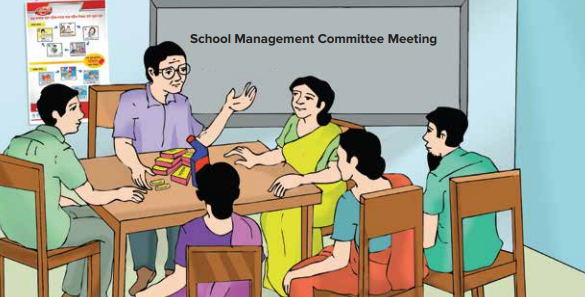
In a major reform aimed at streamlining school governance across India, the Union Ministry of Education has introduced the School Management Committee (SMC) Guidelines 2026, replacing multiple existing committee structures with a single unified framework from Balvatika (pre-primary) to Class 12. The move is being seen as a significant step toward implementing the vision of the Ministry of Education under the framework of the National Education Policy 2020.
Previously, government schools operated with separate bodies — School Management Committees (SMCs) for primary education and School Management Development Committees (SMDCs) for secondary classes. Under the new guidelines, these parallel systems will now be merged into a single committee structure covering all grades.
According to the guidelines released by the Department of School Education and Literacy (DoSEL), committee size will depend on student enrollment. Schools with up to 100 students will have 12–15 members, while larger institutions may have up to 25 members. Importantly, at least 75% of members must be parents or guardians, and half the total representation must consist of women. Representation for disadvantaged groups and children with special needs has also been made mandatory.
The committees will be responsible not only for academic oversight but also for infrastructure monitoring, school development planning, student safety, implementation of welfare schemes, and social audits. Schools will additionally establish two dedicated subcommittees — an Academic Committee and a School Building Committee.
Union Education Minister Dharmendra Pradhan described the reform as an effort to transform SMCs into a “people’s movement” focused on improving learning outcomes and increasing community participation in education.
The guidelines also introduce accountability mechanisms. Schools must prepare a three-year development plan, conduct annual social audits, display compliance information related to the Protection of Children from Sexual Offences Act, and conduct regular safety drills. The government will also use the PRASHAST app to identify and support children with special needs.
Education experts believe the reform could improve coordination and reduce administrative duplication, particularly in schools operating across multiple grade levels. However, some institutions and minority education groups have expressed concerns about implementation challenges and the possible impact on institutional autonomy.
The rollout comes as India pushes for greater decentralisation and community participation in school administration under the NEP 2020 framework. Officials say the new unified system will strengthen accountability, parental engagement, and local ownership of schools across the country’s nearly 15 lakh educational institutions.