
Beyond the Optics: What a Football Moment Teaches Us About Sports in Education
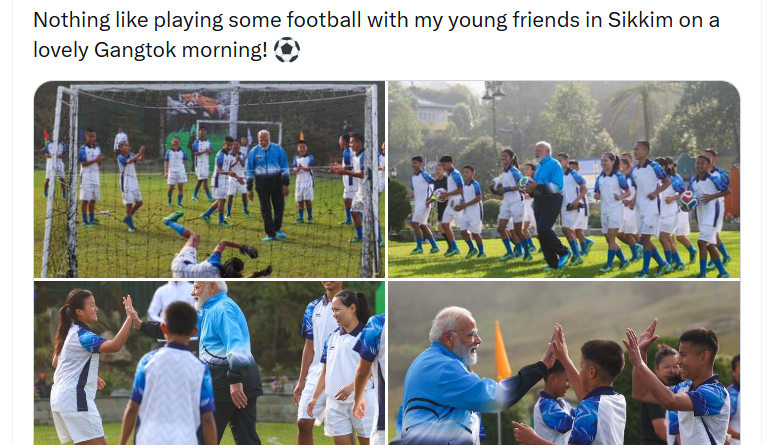
PM Narendra Modi Kicks a Football, Internet Responds with Memes Ahead of Bengal Election PhaseWhen Narendra Modi was recently seen playing football during an election campaign, reactions ranged from admiration to skepticism. For some, it appeared as a calculated political gesture in the heat of the West Bengal Legislative Assembly elections. That interpretation cannot be entirely dismissed. Yet, if we move beyond the immediate political context, the moment carries a deeper and far more meaningful message—especially for students and the education system in India.
Games and sports are not peripheral activities; they are central to human development. For students, in particular, sports cultivate discipline, resilience, teamwork, and emotional balance—qualities that no textbook alone can fully impart. In a country where academic performance often overshadows physical development, even a symbolic gesture that brings sports into public conversation has value.
It is important to acknowledge that the current government has consistently promoted sports through initiatives like Khelo India, which aims to identify and nurture young talent at the grassroots level. Such programs signal a policy-level recognition that sports must be integrated into the national developmental framework.
However, the challenge lies not in symbolism but in systemic implementation. For millions of students across India—especially in government schools—access to playgrounds, trained physical education teachers, and structured sports programs remains limited. The gap between policy vision and ground reality continues to be wide.
This is where the recent football moment becomes significant—not as a political act, but as a conversation starter. If public figures engage in sports, it should remind us of a simple truth: physical activity is not a luxury; it is a necessity. For young minds growing up in an increasingly digital and sedentary world, sports provide balance, energy, and a sense of joy that formal education often overlooks.
From an educational perspective, sports must be treated as an integral part of the curriculum, not an optional extra. Schools should not view games as time away from studies but as an extension of learning itself. A child who learns teamwork on the field often performs better in collaborative academic environments. A student who experiences both victory and defeat in sports develops emotional maturity that textbooks cannot teach.
At the same time, it is equally important to maintain a critical lens. When sports appear in political narratives, we must ask whether they are being used merely as symbolic tools or whether they reflect a sustained commitment to change. Occasional gestures cannot substitute for long-term investment in infrastructure, teacher training, and student participation.
Yet, dismissing such moments entirely may also be a missed opportunity. If even a small fraction of students feel inspired to pick up a ball, step onto a field, or simply move away from screens, the impact is meaningful. Inspiration often begins with visibility.
India today stands at a crossroads in education. The emphasis is gradually shifting from rote learning to holistic development, as envisioned in policies like the National Education Policy 2020. In this transition, sports must occupy a central place. They are not just about physical fitness; they are about building character, confidence, and community.
For parents and teachers, the takeaway is clear. Encourage children to play—not occasionally, but regularly. Allow them the freedom to explore sports without the constant pressure of academic comparison. Recognize that a child running on a playground is also learning—perhaps in ways that matter even more for life.
In conclusion, while the image of a leader playing football during an election campaign may invite debate, it also opens a window for reflection. Beyond politics, it reminds us of something fundamental: a healthy mind grows best in an active body. If this moment can nudge even a small shift in how we view sports in education, it has served a purpose far greater than its immediate context.