

The Lost Art of Concentration: What Today’s Young People Can Learn from Deep Work
In an age of endless scrolling, instant answers and artificial intelligence, the ability to sit quietly with a difficult question may be more valuable than ever.
A young college student sits down to prepare for an examination. She opens her textbook, reads two paragraphs and reaches for her phone. A message has arrived in the class group. Someone has posted a funny video. She watches it, checks a few photographs on Instagram and then returns to her textbook. Within minutes, another notification appears.
An hour passes. She has been at her desk throughout, but when she tries to recall what she has studied, very little comes back to her.
The next morning, she tells her parents that she studied for three hours.
Technically, she is telling the truth. But did she really spend three hours learning?
This ordinary scene captures one of the most important challenges facing young people today. They have access to more information, educational resources and digital tools than any previous generation. Yet access to information and the ability to think deeply are two very different things.
It is this distinction that makes Cal Newport’s book Deep Work: Rules for Focused Success in a Distracted World worth reading. Newport, a computer science professor and author, makes a simple but powerful argument: the ability to concentrate without distraction on a demanding task is becoming increasingly rare, even as its value continues to grow.
His concern is not merely that we waste time on our phones. It is that we may gradually lose the capacity to do the kind of thinking through which real learning, creativity and expertise develop.
The illusion of being busy
We live in a culture that celebrates activity. Students attend classes, prepare assignments, watch educational videos and join online coaching sessions. Young professionals answer emails, participate in meetings and remain available on messaging platforms throughout the working day.
There is always something to do.
But activity can become a convenient substitute for achievement. We may spend an entire day responding to other people’s demands without making meaningful progress on the work that matters most.
Newport distinguishes between two kinds of work. Deep work involves sustained concentration on cognitively demanding activities. Learning a difficult mathematical concept, writing a thoughtful essay, developing a scientific argument or understanding a complex social problem are examples. Shallow work includes routine activities that require relatively little mental effort, such as responding to ordinary messages or completing repetitive administrative tasks.
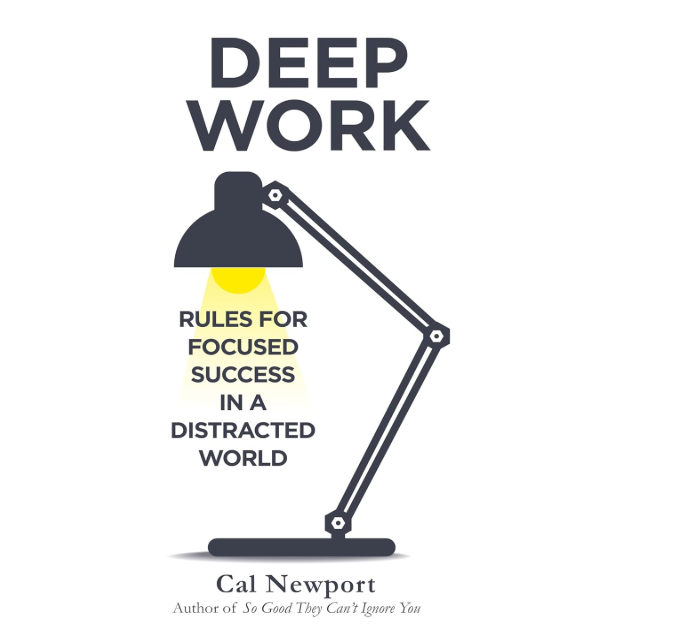
Both have their place. A student must answer emails and a teacher must complete administrative duties. The problem arises when shallow work occupies so much of our attention that little energy remains for deeper thinking.
Imagine two students preparing for the same examination. One spends six hours moving between textbooks, online lectures, messages and revision notes. The other spends three hours working through difficult questions, identifying gaps in understanding and explaining concepts in their own words.
The second student may not always outperform the first. Learning depends on many factors, including prior knowledge, teaching quality and individual circumstances. But uninterrupted, purposeful study gives that student a better opportunity to understand the subject rather than merely become familiar with it.
The important question, therefore, is not simply how long we study. It is what happens to our minds while we study.
What a psychologist’s stone tower can teach us
One of the most striking examples discussed by Newport is the Swiss retreat of the celebrated psychiatrist Carl Jung.
Jung built a stone retreat at Bollingen, on the shores of Lake Zurich, beginning in 1923. The place offered him an escape from the demands of everyday life and an environment in which he could reflect, write and develop his ideas. He later expanded the structure and created a private working space where he could be alone with his thoughts.
Newport uses Jung’s experience to illustrate the importance of deliberately creating conditions for concentrated intellectual work. Jung did not simply hope that inspiration would arrive amid the ordinary demands of the day. He made room for solitude and reflection. <Cite refs={[“turn944091search4″,”turn944091search24”]}/>
There is something worth considering here.
We often imagine that great ideas appear suddenly, as though a brilliant thought descends upon a fortunate mind. In reality, original thinking frequently requires long periods of reading, questioning, making connections and remaining with a problem even when an immediate answer is unavailable.
A young researcher trying to understand climate change, for example, cannot develop a sound argument merely by collecting quotations from websites. The researcher must examine evidence, compare explanations, recognise contradictions and consider alternative interpretations. Such work needs time and concentration.
Of course, young people do not need a stone tower beside a Swiss lake. A quiet corner of a library, a desk at home or even a short period in a classroom without interruptions may provide enough space to begin.
The lesson is not to withdraw from society. It is to create moments when the mind is free from the constant pressure to respond.
The professor who protected his attention
Newport offers another instructive example in Adam Grant, the organisational psychologist and Wharton professor known for his research and writing.
Grant organised his work so that demanding intellectual tasks received sustained attention. During periods devoted to research, he would isolate himself from routine interruptions and concentrate on specific stages of a scholarly paper, from analysing data to drafting and editing. At other times, he remained available to students and colleagues.
His approach was not to ignore his responsibilities. It was to separate activities that required different kinds of attention. <Cite refs={[“turn944091search0″,”turn944091search1”]}/>
This distinction has practical relevance for a young person entering professional life.
A new employee may spend the day replying to messages, attending meetings and completing small requests. At the end of the day, the employee may feel exhausted but realise that the important project assigned a week earlier has barely progressed.
The answer is not necessarily to work late into the night. It may be to reserve a specific period for the project, silence unnecessary notifications and avoid switching tasks until a meaningful part of the work is complete.
The same principle applies to students. Instead of repeatedly interrupting mathematics practice to check a message, they can finish a set of problems first and check their phone afterwards.
Concentration is not an extraordinary gift reserved for a few exceptionally talented people. It is a habit that can be developed, protected and strengthened through practice.
Why boredom matters more than we think
Consider what happens when a young person has to wait five minutes for a friend, stand in a queue or travel a short distance on public transport. The phone often comes out almost automatically.
We have become accustomed to filling every available moment with stimulation. A quiet moment can feel like wasted time.
Yet boredom is not always an enemy. Sometimes it gives the mind an opportunity to wander, reconsider an unresolved question or make an unexpected connection. Reflection does not guarantee a discovery, but a mind that never receives a moment of quiet has fewer opportunities to explore its own thoughts.
Newport argues that concentration must be trained. One cannot expect to focus for an extended period on a difficult task while spending every other moment seeking digital stimulation.
Young people can begin modestly. Read a few pages of a book without checking the phone. Try solving a problem before searching for its solution. Take a walk without automatically putting on a video or podcast. Allow a difficult question to remain unanswered for a while.
These are small exercises, but they encourage a valuable habit: becoming comfortable with one’s own thoughts.
There is an important qualification, however. Boredom should not be romanticised, and every moment of entertainment does not need to serve a productive purpose. Young people need recreation, friendships, music, play and rest. The objective is not to eliminate pleasure. It is to recover the ability to choose what deserves our attention.