
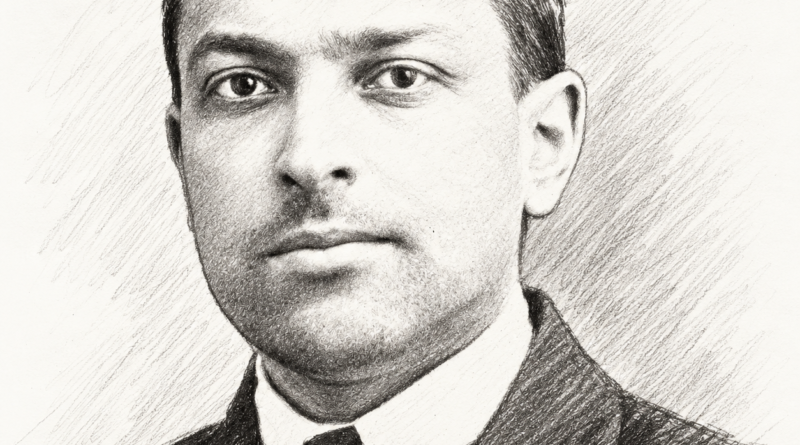
Lev Vygotsky: Why Children Learn Better Together, Even in the Age of AI
Discover Lev Vygotsky’s social learning theory, the Zone of Proximal Development, and the role of language, collaboration, and AI in modern education.
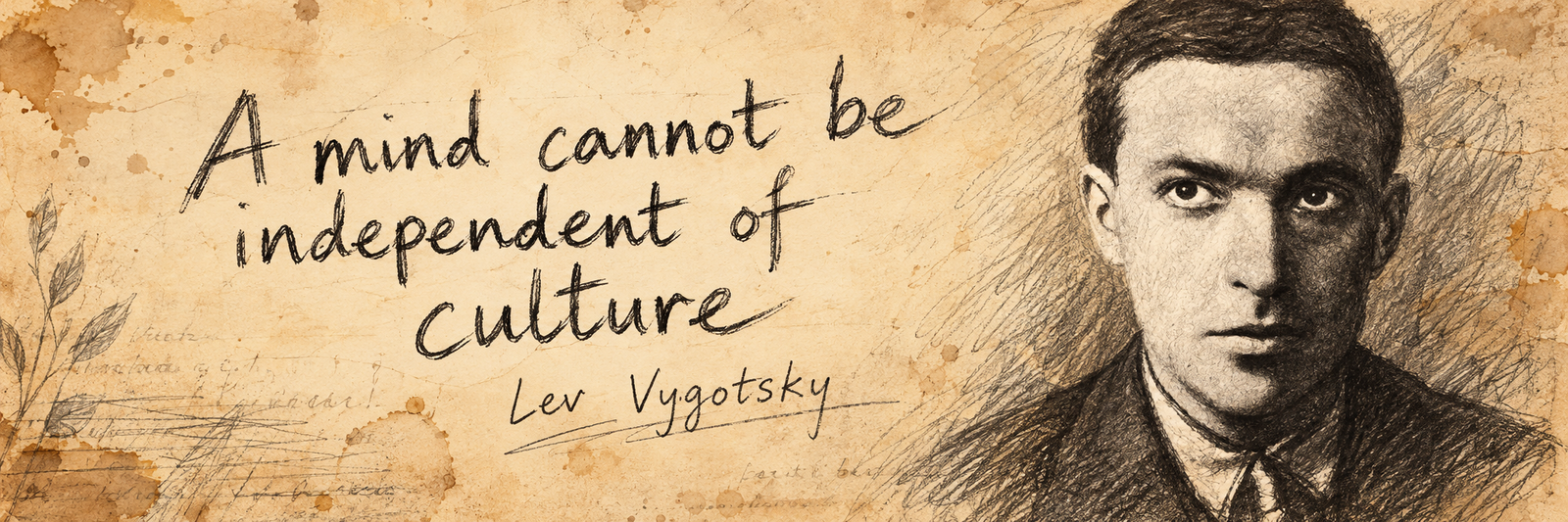
Following Piaget, another great thinker helps us understand why children learn not only by exploring the world, but also by interacting with other people.
In my earlier article on Jean Piaget, I explored a major shift in our understanding of education: the recognition that children are not passive recipients of information. They actively construct knowledge, test their ideas and gradually develop a more sophisticated understanding of the world.
But there is another question worth asking.
Does a child learn entirely through individual exploration? Or does the child’s understanding develop through conversations with parents, interactions with teachers, friendships, language, culture and participation in society?
This is where Lev Vygotsky enters the picture.
Vygotsky, a Russian psychologist who lived from 1896 to 1934, offered a perspective that complements Piaget’s work. He argued that children’s intellectual development cannot be understood fully by looking at the individual child alone. We must also examine the social and cultural environment in which learning takes place.
Today, when artificial intelligence can act as a tutor, explain a difficult concept and respond to a student’s questions at any hour, Vygotsky’s ideas have acquired a new relevance.
His work invites us to reconsider a fundamental question: How can we use technology to help children learn with greater understanding without losing the human relationships through which much of that understanding develops?
1. A brilliant thinker whose ideas travelled slowly
Vygotsky was born in 1896 in the Russian Empire, in what is now Belarus. He studied law and developed interests in literature, philosophy, psychology and education. His work brought together questions about language, thought, culture and human development.
He lived during a period of enormous social and political change. The Russian Revolution and the transformation of society formed part of the intellectual environment in which he worked.
Unlike many psychologists whose influence grew through decades of research and teaching, Vygotsky died of tuberculosis at just 37. His productive academic life was remarkably short.
Much of his work was written in Russian. Political and intellectual circumstances, together with the limited availability of translations, delayed its wider reception among English-speaking scholars. His ideas became increasingly influential in the West from the 1960s onwards, particularly through translations and the work of later researchers.
His most influential educational ideas include the Zone of Proximal Development, the role of language in thinking, and the importance of social interaction in intellectual development.
Vygotsky did not simply add a social dimension to an existing theory of learning. He offered a different way of understanding how the human mind develops.
2. Learning is more than an individual activity
Imagine a young child trying to solve a puzzle. At first, the child picks up pieces randomly. A parent sits nearby and asks, “Can you find the piece with the straight edge?” The child begins to look more carefully. The parent then asks, “Which piece might fit beside this one?”
Gradually, the child recognises patterns and begins to solve the puzzle with less assistance.
What has happened here?
The child has certainly been thinking. But the thinking has developed through interaction with another person. The questions, suggestions and shared activity have helped the child discover a strategy that might otherwise have taken longer to develop.
This is central to Vygotsky’s perspective.
Learning is not simply the transfer of information from one mind to another. It takes place through participation in meaningful activities, conversations and relationships. Over time, strategies that children first use with assistance can become part of their own independent thinking.
Consider how children learn a language. They do not begin by memorising a complete grammar book. They listen to family members, imitate expressions, ask questions, make mistakes and gradually learn to communicate. Their understanding develops through repeated participation in a social world.
The same principle applies to many areas of education. A discussion with a teacher can help a child understand a mathematical idea. Explaining a science experiment to a classmate can reveal gaps in one’s own understanding. Listening to different interpretations of a story can deepen a student’s reading.
For Vygotsky, the social world is not merely the setting in which learning happens. It is an important part of how learning develops.
3. The Zone of Proximal Development: finding the next step
Perhaps Vygotsky’s best-known contribution to education is the Zone of Proximal Development, commonly abbreviated as ZPD. The concept refers to the difference between what a learner can accomplish independently and what the learner can accomplish with appropriate guidance or collaboration.
Think of a child learning to divide fractions.
The child may already understand multiplication and division but struggle to apply these operations to fractions. If the teacher simply repeats the same explanation, the difficulty may remain. If the teacher breaks the problem into manageable steps, demonstrates one example and then invites the child to try another, the learner may succeed. The important question is not merely, “What can this student do today without help?”
It is also, “What can this student learn to do with the right kind of support?”
This distinction has important implications for teaching. A task that is too easy may offer little opportunity for growth. A task that is far beyond a learner’s current understanding may produce frustration. Effective teaching identifies a productive next step and provides enough assistance for the learner to make progress.
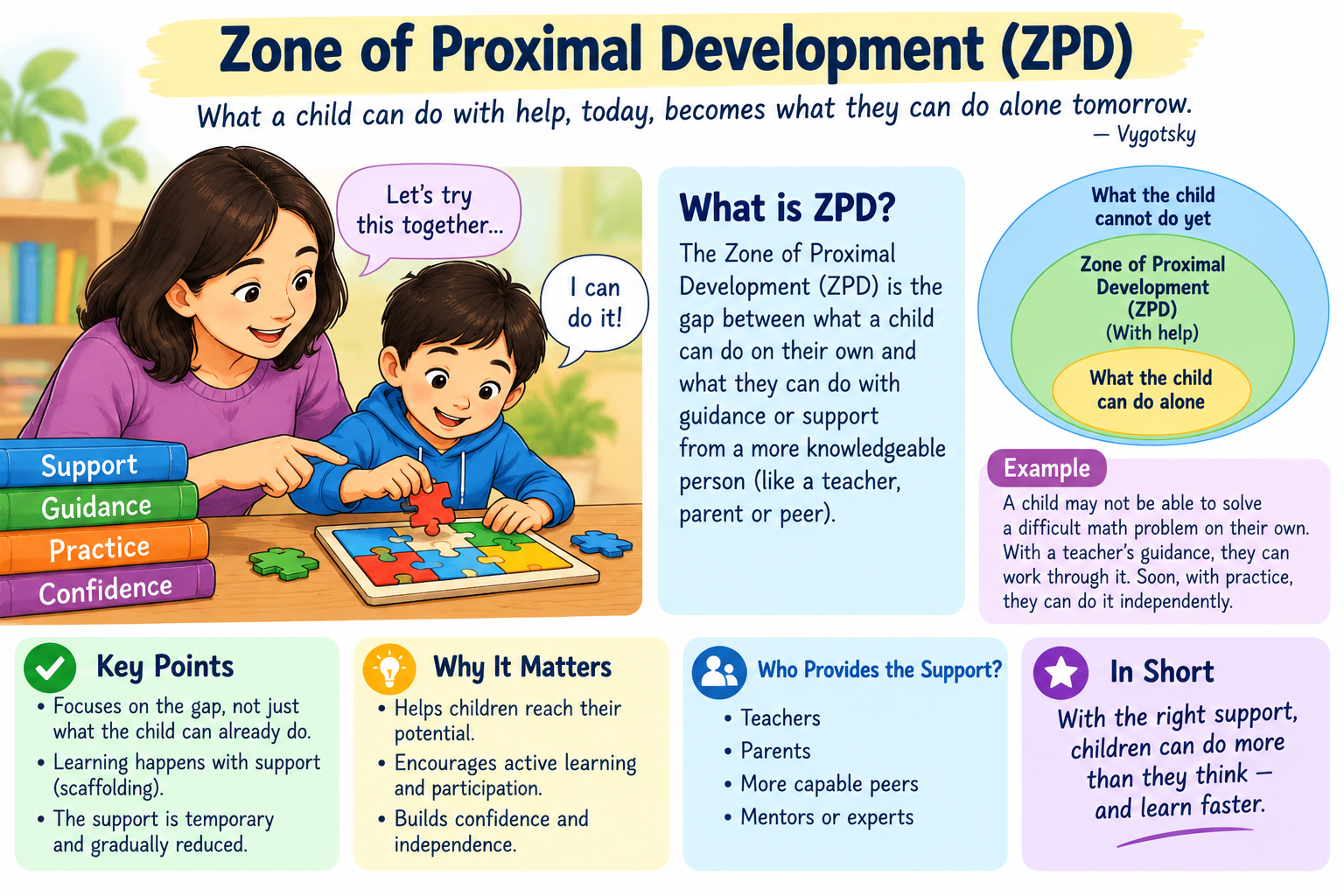
The ZPD also reminds us that a child’s present performance does not tell us everything about the child’s potential. Two students who answer a question incorrectly may need very different kinds of support. One may need a reminder. Another may need a concrete example. A third may benefit from discussing the problem with a peer.
Good teaching begins by understanding the learner’s difficulty.
4. The teacher is not simply a source of information
Vygotsky’s ideas offer a useful perspective on the role of the teacher. In a conventional lecture, the teacher may explain a concept, demonstrate a procedure and ask students to reproduce it. There are situations in which this approach is efficient and appropriate. But a Vygotskian perspective encourages teachers to look beyond the delivery of information. Their task is also to identify where students are struggling and help them move towards greater independence.
A teacher might begin by modelling a process, continue by solving a problem with the class and then ask students to attempt a similar problem on their own.
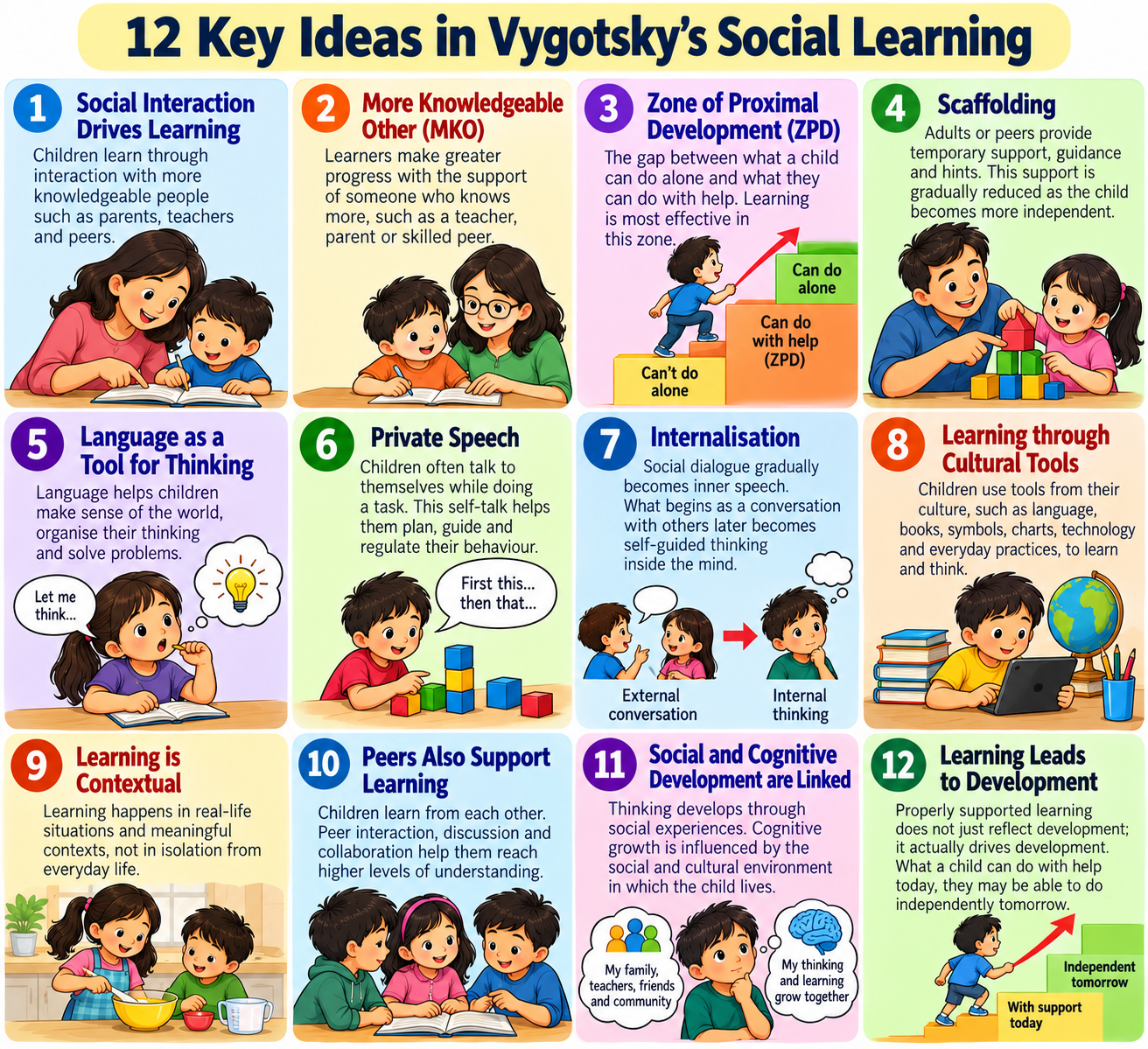
The support changes as the learner develops.
This is often discussed alongside the idea of scaffolding, a term popularised in educational research by David Wood, Jerome Bruner and Gail Ross in 1976. Although closely associated with Vygotsky’s ideas, scaffolding was not a term he himself introduced. The principle is straightforward: assistance should enable learners to do something they could not yet manage independently, and it should be adjusted as their ability grows.
A teacher who gives every answer may create dependence. A teacher who refuses to help may leave students struggling unnecessarily. The challenge is to provide the right assistance at the right time.
5. Language does more than communicate
One of Vygotsky’s most interesting insights concerns the relationship between language and thought.
We often treat language as a tool for expressing ideas that already exist in our minds. Vygotsky’s work suggests a more complex relationship. Language helps us organise our thinking, plan actions, solve problems and regulate our behaviour.
Watch a young child building a tower of blocks.
The child may say aloud, “This one is too big. I’ll put the small one here. No, that won’t work.”
An adult might regard this as ordinary chatter. Yet the child is using language to guide an activity, consider alternatives and manage a problem. Vygotsky referred to this kind of self-directed speech as private speech. He argued that speech used initially in social interaction can become an important means of regulating one’s own thought and behaviour.
This has a practical implication for classrooms.
Students should have opportunities to explain their reasoning, talk through a problem, ask questions and articulate what they do not understand. Silent completion of worksheets cannot reveal every aspect of a learner’s thinking.
It also explains why classroom discussion matters. When students explain an idea in their own words, they are not merely communicating knowledge to others. They may be developing and reorganising their own understanding in the process.
6. Why the social environment matters
Children do not learn in identical circumstances.
The language spoken at home, family experiences, community practices, access to books, opportunities for conversation and expectations about learning all influence how children encounter school education.
Vygotsky’s sociocultural perspective encourages teachers to take these differences seriously.
A child who has grown up helping a parent in a shop may have practical experience of quantities, money and mental calculation. Another child may have developed a strong vocabulary through frequent reading and storytelling. A third may be particularly comfortable learning through practical activities.
These experiences are not substitutes for formal education, but they can provide valuable starting points. The teacher’s responsibility is to connect what learners already know with what they are expected to learn.
This perspective is especially relevant in diverse classrooms in India, where students may speak different home languages, come from different social backgrounds and have unequal access to educational resources.
A child who is still developing proficiency in the language of instruction should not automatically be regarded as lacking intellectual ability. The difficulty may lie partly in the language through which the concept is being taught.
Teachers who recognise this distinction can create more inclusive learning environments.
7. What Vygotsky adds to our understanding of Piaget
Piaget and Vygotsky are often presented as opposing thinkers. That comparison can be useful, but it can also be misleading. Piaget emphasised how children actively construct knowledge through interaction with their environment. Vygotsky gave greater attention to the social, cultural and linguistic processes through which development takes place.
Their perspectives raise different but complementary questions.
Piaget encourages us to ask how a child understands an experience and how that understanding changes. Vygotsky encourages us to ask how dialogue, guidance, language and participation help the child develop new ways of thinking.
Consider a child learning geometry.
A Piagetian approach might focus on exploring shapes, manipulating objects, noticing patterns and developing concepts through experience.
A Vygotskian approach might focus on how a teacher’s questions, a peer’s explanation, mathematical language and collaborative problem-solving help the child understand relationships between shapes.
A thoughtfully designed lesson can combine both.
Students can explore independently, discuss what they discover, receive guidance when needed and gradually learn to solve more complex problems.
The two perspectives remind us that education must respect both the active mind of the learner and the social world in which that mind develops.
8. Vygotsky in the age of artificial intelligence
Now consider the classroom of today.
A student struggling with algebra can ask an AI tool for an explanation. The system can generate simpler examples, offer hints, demonstrate alternative approaches and respond to follow-up questions. In some respects, this resembles the kind of guided assistance that Vygotsky’s theory helps us understand.
An AI tutor might begin with a simple question, identify a student’s difficulty and offer a hint rather than immediately supplying the answer. It might gradually increase the complexity of the task as the learner becomes more confident.
Such applications could make individualised support available to students who might otherwise have to wait for a teacher’s attention.
But an important distinction must be maintained.
AI can provide assistance that resembles some forms of guided learning, but that does not make it equivalent to a human teacher, a knowledgeable peer or a genuine social relationship.
Vygotsky’s theory concerns more than the delivery of personalised explanations. It concerns the social and cultural processes through which human thinking develops.
An AI system may respond convincingly to a student’s words, but it does not participate in classroom life in the same way as a human being. It cannot fully replace the shared experiences, relationships, cultural understanding and mutual responsibilities that make human learning social.
The educational opportunity lies in using AI to extend good teaching, not to remove the human element from it.
9. Three ways teachers can apply Vygotsky’s ideas to AI-supported learning
First, use AI to provide hints rather than finished answers.
Suppose a student cannot solve a mathematics problem. Instead of asking AI for the complete solution, the student can ask for one hint at a time. The teacher can then check whether the student understands the reasoning and can apply it independently.
The aim is to make progress, not simply to complete the exercise.
Second, combine AI assistance with discussion.
Students can use AI to explore a topic, then compare its explanation with a textbook, discuss differences in small groups and present their conclusions to the class.
The discussion helps students articulate their thinking and examine ideas from different perspectives. It also makes the accuracy of AI-generated information a subject of learning.
Third, gradually reduce dependence on assistance.
A teacher might allow students to use AI while learning a new concept, ask them to solve a related problem with limited help and finally assess their understanding independently.
This progression helps distinguish between successful task completion and genuine learning.
These approaches are consistent with UNESCO’s emphasis on human-centred, age-appropriate and responsible uses of generative AI in education. Its guidance stresses the importance of protecting learners, developing human capacity and ensuring that technology supports rather than displaces human agency.
10. The danger of confusing assistance with learning
There is a concern that deserves attention.
When a student submits an excellent essay generated largely by AI, the final product may give the impression of considerable understanding. But the student may have done little of the intellectual work required to produce it.
The same problem arises when students copy AI-generated explanations, solutions or project reports without examining them.
From a Vygotskian perspective, the important question is not whether assistance was used. Assistance is often essential to learning. The question is whether that assistance helped the learner develop the capacity to think and act more independently.
A student who uses AI to understand a difficult concept and subsequently explains it in their own words has had a different experience from a student who simply copies the answer.
Schools therefore need assessment methods that reveal how students think. Teachers can ask learners to explain their work orally, discuss the choices they made, respond to follow-up questions, demonstrate a process or apply the same concept in a new situation.
These methods need not eliminate AI from education. They can help ensure that its use contributes to learning rather than concealing the absence of it.
11. What does this mean for the future of schooling?
The future classroom is unlikely to be defined simply by whether teachers use AI. The more important distinction will be how they use it.
A classroom may have sophisticated technology and still encourage passive learning. Students may spend hours interacting with digital systems while doing little independent reasoning or meaningful collaboration.
Conversely, a classroom with limited technology can offer rich learning through discussion, experimentation, shared reading, practical work and thoughtful guidance.
Vygotsky reminds us that education is not merely an individual encounter with information. It is also a process through which people develop the language, habits of thought, knowledge and capabilities needed to participate in society.
For teacher education, this means preparing teachers to understand not only their subjects and digital tools, but also how students learn from one another, how language shapes understanding and how assistance can be adjusted to individual needs.
For curriculum designers, it means creating room for collaborative projects, dialogue, guided practice and activities that connect classroom knowledge with students’ lived experiences.
For policymakers, it means evaluating educational technology by asking whether it improves learning, inclusion and human development, rather than measuring success simply by the number of devices distributed or AI tools introduced.
My reflection: learning is a human enterprise
Piaget helped us recognise the active learner. Vygotsky asks us to look more closely at the relationships that help that learner grow. The two ideas matter enormously in a world where information is increasingly accessible, and artificial intelligence can respond to almost any question.
A child needs opportunities to explore independently. But children also need teachers who recognise their difficulties, classmates who offer different perspectives, adults who encourage curiosity and communities that give learning meaning.
AI may help us extend some forms of guidance and make educational support more widely available. Used thoughtfully, it can help a teacher respond to different learning needs and enable a student to explore ideas beyond the limits of a conventional lesson.
Yet the presence of technology does not guarantee the presence of learning.
The challenge is to ensure that children do not become merely efficient consumers of machine-generated answers. They must learn to question, explain, collaborate, evaluate and think for themselves.
Vygotsky’s work offers a valuable reminder that intellectual growth takes place through participation in a world of people, language and shared experience.
Perhaps that is the question we should carry into the AI-enabled classroom: not simply whether a machine can teach a child, but whether the learning experience helps that child become a more capable, thoughtful and independent human being.
That is a much more demanding goal than delivering information. It is also a far more worthwhile one.
Suggested references
- Vygotsky, L. S. (1978). Mind in Society: The Development of Higher Psychological Processes. Harvard University Press.
- Vygotsky, L. S. (1986). Thought and Language. MIT Press.
- Wood, D., Bruner, J. S., & Ross, G. (1976). The role of tutoring in problem solving. Journal of Child Psychology and Psychiatry, 17(2), 89–100.
- UNESCO (2023). Guidance for Generative AI in Education and Research.