
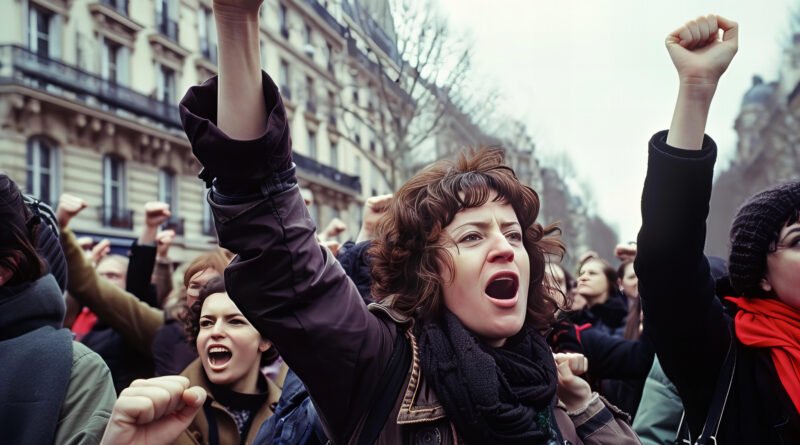
France’s Student Protests and India’s Education Challenge: Beyond Politics, Back to the Classroom
France: when a school crisis becomes a social crisis

A student protest that began over missing teachers in a Paris suburb has become a national political crisis. India should pay attention, not because France and India are the same, but because both countries raise the same fundamental question: what does education reform actually mean for the child?
On 21 September 2026, a group of students at Lycée Saint-Exupéry in Créteil, a working-class suburb southeast of Paris, began blocking their school.
The immediate trigger was not immigration, religion or a grand ideological dispute.
It was much more basic.
There were not enough teachers.
Students and teachers were frustrated by vacancies, overcrowded classrooms, deteriorating facilities and uncomfortable classrooms during periods of extreme heat. Within days, what looked like a local school dispute began spreading to other schools in the Paris region and then across France.
By 1 October, France’s Education Ministry said that more than 1,020 high schools had been affected by strikes or protests, including 222 blockades. That meant roughly one in four high schools in the country was affected.
By 6 October, the protest had become a national mobilisation.
The French Interior Ministry estimated 266,000 participants nationwide, including 56,000 in Paris. Student organisations put the figure much higher, at around 450,000 nationally. The demonstrations involved students, teachers, parents and trade unions.
The figures differ, but the underlying message is difficult to ignore.
Something had gone wrong in the relationship between students and the education system.
And that is where the French story becomes relevant to India.
What brought French students onto the streets?
The demands are strikingly practical. Students want teachers to be present. They want smaller and more manageable classes. They want functioning toilets, properly maintained buildings and classrooms that are usable during hot weather. They object to excessively long school days.
They are also questioning Parcoursup, France’s higher-education admissions platform, which they argue can reproduce socioeconomic inequalities and add uncertainty to an already stressful transition from school to university.
The research material supplied for this article identifies precisely these concerns: teacher shortages, classroom overcrowding, rigid timetables, poor climate control, deteriorating buildings and concerns about the transparency and equity of Parcoursup.
That is an important point.
The French movement did not begin with a political manifesto. It began with the experience of students inside their schools. At Saint-Exupéry in Créteil, students described classrooms that became unbearably hot, toilets that were frequently unusable and continuing shortages of staff. Teachers also reported that some students had waited weeks for regular lessons in particular subjects.
In other words, the protest began with a simple question:
“Why isn’t our school functioning properly?
From school grievance to political movement
Politics, however, soon entered the picture.
The left-wing party La France Insoumise (LFI), led by Jean-Luc Mélenchon, became one of the most visible political supporters of the student movement. On 23 September, LFI MPs Clémence Guetté and Louis Boyard visited the Créteil school and publicly supported the students. Boyard’s social media video reportedly received around 1.5 million views. Other LFI politicians subsequently appeared at school blockades.
Mélenchon himself accused the government of repressing students and called on elected officials and activists to support the mobilisation. The government saw the situation differently.
Prime Minister Sébastien Lecornu acknowledged that students had genuine grievances but accused political actors of encouraging blockades and warned against violence. Interior Minister Laurent Nuñez described some incidents as urban violence.
This created the first major political fault line. The government was essentially saying:
Listen to the students, but don’t allow political groups to use them.
The opposition was saying:
The government is using law-and-order arguments to avoid confronting the educational crisis.
Both arguments became part of the public debate. And that is precisely where the French experience becomes interesting for India.
A genuine grievance can be politically appropriated
There is a temptation in political debate to make everything binary. Either the students are genuinely angry, or a political party is behind the protest. Reality is usually more complicated. A movement can begin with a legitimate grievance and later attract political organisations.
Political parties may amplify a genuine problem while simultaneously trying to gain political advantage from it. Both things can be true. That distinction is particularly important because the French protests were not initially created by LFI. The movement emerged from school-level dissatisfaction before political parties became prominent.
That does not make subsequent political involvement irrelevant.It simply means we should not confuse the cause of a protest with the politics that later surrounds it.
India needs to remember this distinction.
The French government’s response
The government has now been forced to respond to the substance of the complaints. Education Minister Édouard Geffray announced a platform through which students could report problems and said the government would prepare an action plan addressing specific schools. Prime Minister Lecornu has also ordered ministers to examine teacher replacement, school-day length, lunch breaks and repairs to ageing school buildings, with initial proposals expected by the end of October.
But the protests have also become increasingly confrontational.
On 5 October, a 15-year-old student in Lens suffered catastrophic injuries after picking up a police dispersal grenade during clashes. Rights groups have questioned police tactics, while authorities have investigated several incidents involving violence and damage. By 6 October, the government reported hundreds of arrests and significant injuries among protesters, school staff and police. The tragedy is that once an education movement reaches this stage, the original question can disappear beneath the politics of protest.
The debate becomes:
Who is responsible for the violence?
Instead of:
Why did students feel they had to block their schools in the first place?
That is a dangerous transition for any democracy.
And now, India
India has its own version of this debate. In recent months, education-related protests have increasingly combined genuine student concerns with political mobilisation.
The Cockroach Janta Party (CJP) has been one of the organisations drawing attention to education issues, including its “School Thik Karo” campaign. Its activists have inspected government schools and highlighted problems involving classrooms, basic facilities, sanitation, teacher availability and school infrastructure. In September, for example, CJP activists conducting inspections in Udaipur district raised concerns about unsafe buildings and poor conditions in school kitchens.
The central question raised by such campaigns is legitimate:
Are India’s government schools providing the basic environment that children deserve?
Of course they should be examined. But India should ask a second question at the same time:
Is education reform becoming another instrument of political mobilisation?
That question should not be directed at CJP alone.
It should be asked of every political party and every organisation.

The AAP and Delhi experience
Delhi provides an especially useful case study because the Aam Aadmi Party made school education one of the most visible components of its governance narrative.
There were genuine achievements. School buildings were renovated. Classrooms and facilities were improved. Teacher training and school leadership received greater attention.
Government schools received a degree of public visibility that they had not previously enjoyed. It would therefore be unfair to claim that nothing happened. But there is a more difficult question that should be asked of any government:
Did the visible investment translate into deep, sustained improvement in learning?
That is a different question.
A renovated classroom is an input.
A functioning laboratory is an input.
A smart board is an input.
A trained teacher is an input.
But reading comprehension, mathematical reasoning, scientific thinking, creativity and problem-solving are outcomes.
The distinction is crucial.
India’s own education data show that the country has made substantial progress in school infrastructure and access. NITI Aayog’s 2026 review, based on UDISE+, PARAKH, NAS and ASER data, reports improvements in electricity, sanitation, inclusive infrastructure and digital access, as well as signs of recovery in foundational literacy and numeracy. At the same time, it identifies continuing systemic and academic challenges.
So the debate should not be:
Infrastructure versus learning.
We need both.
The real problem arises when infrastructure becomes the headline measure of educational success. A school can look dramatically better while children continue to struggle with basic reading and mathematics.
India’s larger political anomaly
This leads to a much bigger question.
Why does education rarely become a central political priority in India in the same way that subsidies, caste representation, religious identity, electricity, employment schemes and welfare promises do?
Education appears in almost every election manifesto. But the political rewards from education reform are slow. A free benefit can be felt immediately. A new road can be seen immediately.
A new school building can be photographed immediately. But if a government introduces a high-quality foundational literacy programme for six-year-olds, the full benefit may not be visible for another five or ten years.
Political systems naturally gravitate towards policies whose benefits can be demonstrated before the next election.
Education does not work like that.
Education is a long-term investment trapped inside a short-term political cycle.
That may be one of India’s greatest policy anomalies.
The real question is not who is protesting
This is where the French experience offers India a useful lesson. We should not become obsessed with identifying whether a protester belongs to the left, right, centre or a particular organisation.
The first question should be:
Is the underlying grievance real?
If the answer is yes, investigate it. Then ask:
Is the protest peaceful and lawful?
If yes, engage with it. If there is violence, deal with the violence according to law.
But do not allow the law-and-order question to erase the educational question.
The same principle should apply to political parties. If an opposition party raises a genuine education problem, the government should not reject the problem merely because the opposition raised it. If a ruling party introduces a successful education reform, the opposition should not reject it merely because it came from the government.
Education policy should be bigger than political ownership.
What India should actually measure
The answer is not another slogan such as “Education First”.India already has enough slogans. What we need is a public School Quality Dashboard that every parent can understand. It should track five basic things.
1. Learning
Can children read with understanding?
Can they perform age-appropriate mathematics?
Can they apply knowledge rather than simply reproduce answers?
2. Teachers
Are vacancies filled?
Are teachers deployed where they are needed?
How much professional development do they receive?
3. Infrastructure
Are classrooms safe?
Are toilets functional?
Is drinking water available?
Are libraries and laboratories usable?
4. Equity
Are children from poorer, rural, tribal and disadvantaged communities progressing at the same rate?
5. Student wellbeing
Are children attending?
Are they dropping out?
Do they have access to counselling?
Do they feel safe?
NITI Aayog’s 2026 report actually moves in this direction, proposing measurable indicators and implementation pathways across infrastructure, teacher deployment, pedagogy, assessment, wellbeing, equity and governance.
The challenge is not designing another framework. The challenge is implementing it consistently.
The opportunity before India
The French experience should therefore not be read as a prediction of what will happen in India. It should be read as an opportunity to reflect.
India has already embarked on a substantial process of education reform through NEP 2020, with a clear shift towards foundational literacy and numeracy, competency-based learning, multidisciplinary education, better assessment and greater use of technology. Initiatives such as NIPUN Bharat, PARAKH and PM SHRI are attempts to translate that vision into practice.
There is also measurable progress. The latest UDISE+ data record more than 24.7 crore students, 1.03 crore teachers and 14.67 lakh schools, alongside improvements in teacher availability, pupil-teacher ratios, retention, transition and school infrastructure.
The task now is to build on that progress.
The next phase of reform should move even more firmly from access to quality, from infrastructure to learning, and from policy announcement to classroom implementation.
That means filling remaining teacher gaps, strengthening teacher development, using assessment data to identify learning difficulties early, giving greater attention to foundational literacy and numeracy, improving counselling and student wellbeing, and ensuring that children in disadvantaged communities are not left behind.
It also means listening to criticism without allowing education to become merely another arena for political confrontation.
Student organisations, civil-society groups and political parties have an important role in drawing attention to genuine problems. Governments, in turn, should be willing to examine uncomfortable criticism when the evidence supports it. But the ultimate test should remain the same for everyone.
Does this reform help a child learn better?
That is a question on which political parties can disagree about methods but should be able to agree about the goal.
India has the advantage of scale, a young population, a growing digital ecosystem and an education policy that already provides a broad framework for transformation. What is needed now is sustained implementation, honest measurement and continuity across governments.
France reminds us that unresolved educational grievances can eventually become public protests.
India has the opportunity to learn a different lesson: listen before frustration grows, measure before claiming success, improve before announcing victory, and preserve what works even when political leadership changes.
Education reform should ultimately become a national project rather than a partisan possession.
The success of NEP 2020 will not finally be measured by the number of policies issued, schools renovated or programmes launched. It will be measured years from now in the abilities of young Indians: what they can read, what they can understand, what they can question, what they can create and how confidently they can participate in the world.
That is where India’s education story should now move: from reform as a political promise to reform as a sustained improvement in the life and learning of every child.