
Can World-Class Education Be Achieved Without an Elite School or Hefty Fees?
Can world-class education be achieved without an elite school? Explore how AI, open resources, technology and learning communities can transform access to quality education.
For generations, we have associated a good education with a good school.
In India, this association has become particularly strong. Parents compete for admission to reputed schools, pay substantial fees, arrange tuition and coaching, and then begin thinking about the next destination: a prestigious college, a professional degree and, eventually, a good career.
The name of the institution often becomes a shorthand for the quality of education a child is expected to receive.
But there is a question we rarely ask:
Does a child really need an elite school or college to receive a world-class education?
I believe the answer is increasingly becoming NO. This does not mean that schools and colleges are becoming irrelevant. Nor does it mean that every child should abandon conventional schooling and sit at home with a laptop.
The possibility is much more interesting. We may be entering a period in which the school is no longer the entire educational ecosystem.
What exactly is a world-class education?
Before talking about technology, artificial intelligence or online learning, we need to ask what we actually mean by “world-class education”.
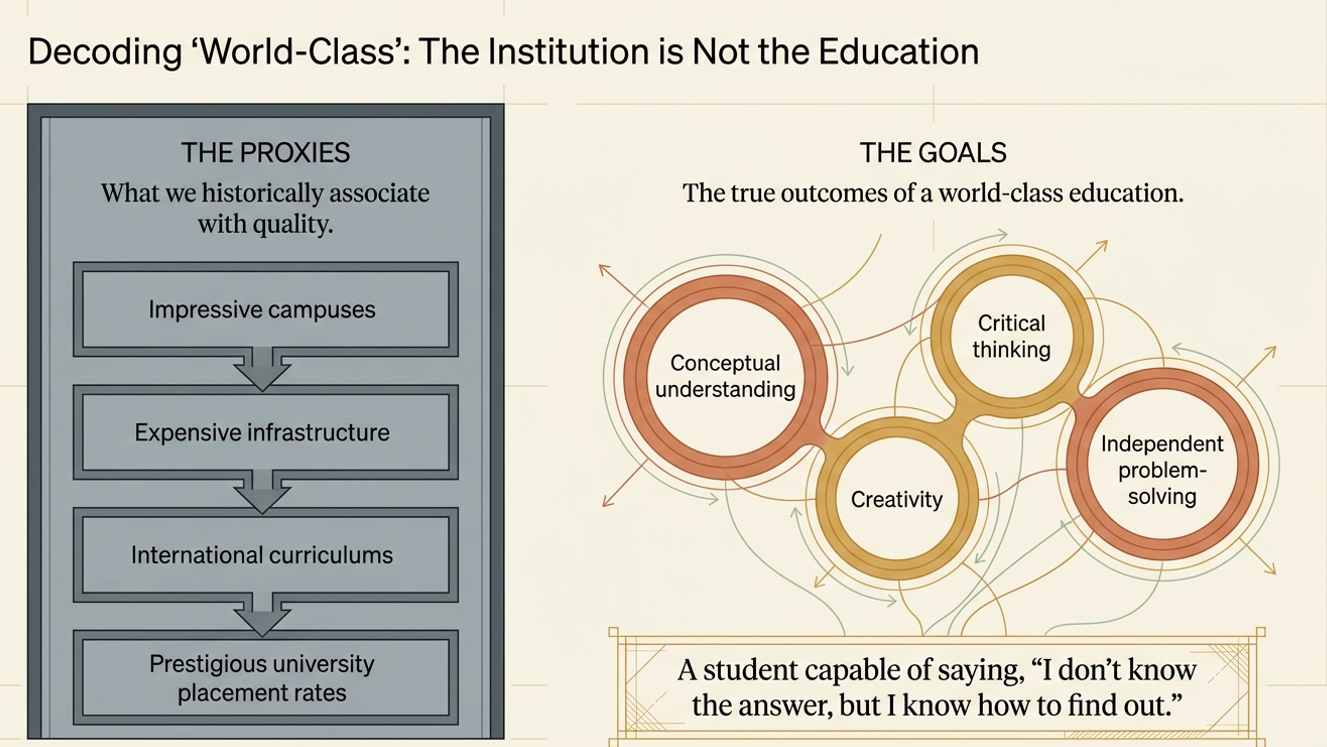
Is it an impressive campus?
Is it an international curriculum?
Is it expensive infrastructure?
Is it the number of students entering prestigious universities?
These things may have value, but they are not education itself.
A genuinely good education should develop curiosity, conceptual understanding, critical thinking, communication, creativity, problem-solving and the ability to learn independently. It should expose children to different ideas and cultures and teach them how to investigate questions rather than merely memorise answers.
A child should eventually be capable of saying:
“I don’t know the answer, but I know how to find out.”
That may be one of the most important outcomes of education. And if these are the things we want education to accomplish, why should we assume that all of them must come from one expensive institution?
That is where the education landscape is beginning to change.
The walls of the classroom are becoming less important
For most of human history, learning was closely tied to physical proximity. If you wanted to learn from a particular teacher, you went to that teacher. If you wanted access to a particular library, you went to that library. If you wanted to study at a particular university, you had to be admitted to that university.
The internet has begun to break this connection between place and knowledge.
Consider MIT OpenCourseWare. MIT currently makes material from more than 2,500 courses available openly, including lecture notes, assignments, examinations, textbooks and, for many courses, video lectures. There is no enrollment requirement and no fee for accessing the material. It does not provide a degree or academic credit, but it gives independent learners access to a remarkable body of university-level knowledge.
India has its own powerful example in SWAYAM. The Government of India’s platform provides courses from school level through postgraduate education, with video lectures, reading material, assessments and discussion forums. Its NPTEL component offers learning from IIT faculty and other experts, with course learning available at no cost and optional certification examinations.
Khan Academy has built another model around the idea of providing free learning resources to learners. Its Khan Academy Kids programme, for example, provides thousands of learning activities free to families and teachers.
These are not substitutes for an entire school. But that is precisely the point.
They are additional gateways to knowledge that did not exist at this scale for earlier generations. A child sitting in an ordinary home in India can now potentially explore subjects using resources created by institutions and educators from around the world. The geographical location of the child does not have to determine the quality of every learning experience.
From school education to a personal learning ecosystem
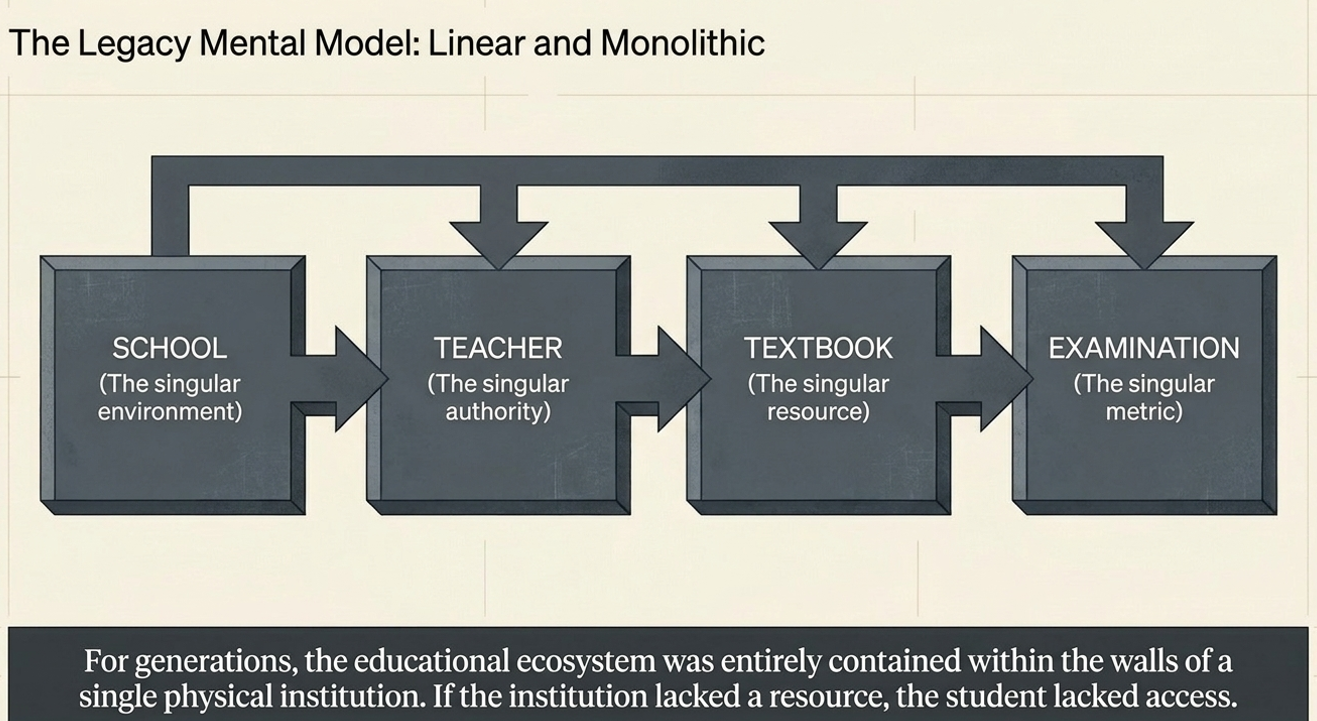
This leads to a different way of thinking about education. For a long time, our mental model has been:
School → Teacher → Textbook → Examination
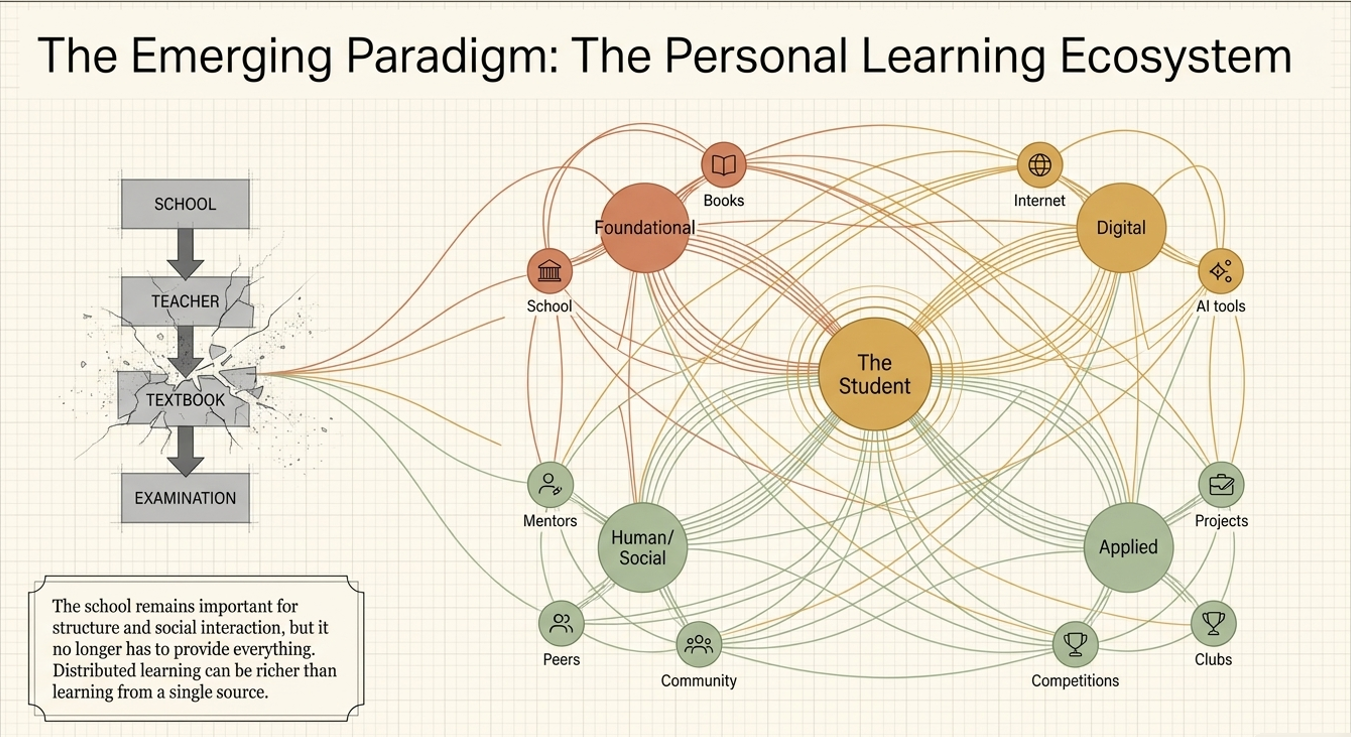
The emerging model could look more like:
School + Books + Internet + AI + Mentors + Projects + Competitions + Clubs + Peers + Community
This is what I would call a personal learning ecosystem.
The school remains important. It provides structure, teachers, assessment, social interaction and a recognised educational pathway. But it does not have to provide everything.
A student might learn mathematics from a school teacher, explore advanced mathematics through an online course, read a book independently, use an AI tool to clarify a difficult concept, participate in a mathematics club and work with other students on a project.
The learning experience becomes distributed. And sometimes, distributed learning can be richer than learning from a single source.
But what about friends and social interaction?
This is the strongest objection to the idea of learning outside conventional schools.Children need other children. They need friendship, conversation, disagreement, teamwork, competition and the experience of working with people who think differently. I agree completely.
But perhaps we have made an unnecessary assumption: that meaningful social interaction can happen only inside a conventional school. Imagine a growing number of children learning through different combinations of school, home education, online resources and independent study.
They would still need places to meet. Some would join science clubs. Others would join robotics and coding groups. There could be mathematics and Olympiad communities, debate societies, theatre groups, music workshops, sports academies, art studios and makerspaces. Students could meet at libraries or community learning centres.
A child might spend much of the week learning independently but meet twenty or thirty other children every Saturday for a science project. Another group might meet twice a week to build robots. Another might work together on a documentary, a community research project or a small business idea. The internet may actually create a demand for new forms of physical community.
This is the part of the story that I find particularly fascinating. Children may learn individually but come together collectively.
The learning club could become a new educational space
Imagine a learning centre that doesn’t look much like a conventional school. There may be a laboratory, a library, a computer room, a makerspace, discussion rooms and facilities for music, art and theatre.
There may be mentors rather than hundreds of permanent teachers. Students don’t necessarily come because they belong to the same grade. They come because they share an interest.
One group is working on robotics.Another is preparing for a mathematics competition.
Another is studying astronomy. A group of younger children is writing stories.Some students attend every day. Others come only on weekends.They learn through online resources during the week and use the physical centre for collaboration, experimentation and mentorship.
This could become a new kind of educational institution.It would not be entirely a school.
It would not be entirely a coaching centre.It would not be entirely a library.It would be something in between. Perhaps we should call it a learning community. And we may be seeing only the beginning of this possibility.
Artificial intelligence adds another dimension
AI makes the idea even more interesting. For the first time, a learner can interact with a digital system that can explain an idea in different ways, generate practice questions, help organise a project, provide feedback on writing, assist with coding and adapt explanations to the learner’s questions.
A student who doesn’t understand quadratic equations can ask for a simpler explanation.A curious student can ask to go beyond the textbook. A child interested in astronomy can continue asking questions until the conversation reaches a level far beyond the school chapter.
But we should be careful here. AI is not education. It is a tool within an educational ecosystem. A child still needs teachers, parents, mentors, friends, books, experiments and real-world experiences.The danger would be to replace one rigid system with another, where children simply spend more hours talking to machines. The real opportunity is to use AI to make human learning more personalised and more accessible.
Elite institutions may not disappear. Their monopoly may weaken.
This argument should not be misunderstood as an attack on elite schools or universities.
Good institutions provide things that are genuinely valuable: excellent teachers, laboratories, libraries, structured learning, peer groups, mentorship, networks and recognised qualifications. These advantages matter.
But technology may gradually weaken the monopoly that institutions once had over access to knowledge. A student may not be able to reproduce the complete MIT or Harvard experience at home. But that student can increasingly access some of the knowledge, courses, books, lectures and intellectual resources associated with leading institutions.
That distinction is important. We should not confuse access to knowledge with access to an institution.They are no longer exactly the same thing.
The real challenge is not information. It is learning.
There is also a danger in becoming overly romantic about technology. A child with a smartphone and an internet connection does not automatically receive a world-class education. There is an enormous amount of poor-quality information online.
Children can become distracted. They can lose discipline. They may not know how to distinguish reliable information from misinformation. They may need help selecting resources and designing a meaningful learning path. This is where parents, teachers and mentors become even more important. The future learner may need less of a traditional “content provider” and more of a learning guide.
Someone who asks:
What are you trying to understand?
Why are you interested in it?
What have you discovered?
What evidence supports your conclusion?
What could you do with what you have learned?
That is education.
A different future may be emerging
Today, the pieces are still scattered. A child may attend school during the day, take coaching classes in the evening, watch educational videos at night and occasionally use an AI tool for help.But imagine these pieces becoming deliberately connected.
A student could study foundational subjects through school or another structured pathway, use open university resources to explore areas of interest, work with an AI learning assistant, meet a mentor, participate in a local learning club, collaborate with peers and build a portfolio of projects.
The child might learn from a teacher in India, watch a lecture from a university abroad, collaborate with students in another city and meet a local group of learners every weekend.
The physical and digital worlds would complement each other.This is why I don’t think the future question is simply:
“Will online education replace schools?”
That is probably the wrong question.The more interesting question is:
“What happens when a child no longer depends on one institution for the whole of his or her education?”
From elite schools to elite learning ecosystems
Perhaps this is where the real transformation lies. We have spent decades trying to make high-quality institutions available to more children.The next challenge may be different.
Can we make high-quality learning available to more children?
A child from a wealthy family may have access to an expensive international school, private tutors, laboratories, sports facilities and overseas exposure. A child from an ordinary family may not have those advantages.But if that second child can access excellent books, open university courses, high-quality digital resources, AI-assisted learning, mentors, local laboratories, sports clubs, competitions and a community of motivated learners, the difference in educational opportunity could begin to narrow. It will not disappear. Money will still provide advantages.
Technology will not magically eliminate inequality. But the walls are becoming less solid.
And that matters. Perhaps the future of education will not be a world without schools.
Perhaps it will be a world in which schools are no longer the only gateways to world-class learning.
The school will remain.
The teacher will remain.
The peer group will remain.
The need for human connection will remain.
But around them, a much larger ecosystem may develop.And perhaps the question for parents in the coming decade will no longer be only:
“Which is the best school I can get my child into?”
It may become:
“How can I build the best learning ecosystem I can around my child?”
That is a very different question. And if we are only at the beginning of this transition, it may also be one of the most important questions in education today.