
Piaget’s Theory: Core Lessons for Education in the AI Age
Discover how Jean Piaget transformed our understanding of how children learn and explore what his groundbreaking ideas mean for AI-powered education, modern teachers, and today's changing classrooms.
[Jean William Fritz Piaget (9 August 1896 – 16 September 1980) was known for his work on child development]
There was a time when much of educational thinking revolved around a fairly straightforward question: How can we make children learn what we want them to learn? The answers often involved repetition, practice, rewards, punishment and the measurement of observable performance. If a child gave the correct answer, learning was presumed to have taken place. In the early twentieth century, behaviourism became an influential approach to understanding learning. Edward Thorndike’s work on connectionism and the law of effect, John B. Watson’s emphasis on observable behaviour, and B. F. Skinner’s later research on operant conditioning highlighted practice, repetition, reinforcement and feedback. These ideas influenced educational methods such as drills, programmed instruction and the measurement of learning through observable performance.
This approach had its place in the development of educational psychology. But it left an important question insufficiently explored: What is actually happening inside a child’s mind when learning takes place?
It was this question, among others, that made the work of Jean Piaget so significant. His research helped redirect attention from the observable behaviour of the learner to the development of the learner’s thinking. The implications for education were profound. To appreciate Piaget’s contribution, however, we must first understand the educational thinking that preceded him and the intellectual conversations that followed.
Piaget and the discovery of the child’s mind
Jean Piaget approached the problem from a different direction. Instead of concentrating primarily on how behaviour could be shaped, he investigated how children’s understanding develops.
His observations suggested that children do not simply possess less knowledge than adults. Their ways of reasoning can be qualitatively different. As they grow and interact with their surroundings, they construct and reorganise their understanding of the world.
Piaget’s concept of the schema helped explain how learners organise experience into mental structures. Through assimilation, they interpret new experiences using existing structures. Through accommodation, they modify those structures when experience no longer fits what they previously believed. Equilibration describes the broader process through which these changes contribute to increasingly coherent understanding.
Consider a child who sees an aeroplane for the first time and calls it a bird. The child is not necessarily being careless. The child is interpreting an unfamiliar object through an existing understanding: birds fly, and this object flies too. As the child learns about engines, machines and the construction of aeroplanes, that initial understanding changes.
For the teacher, this offers an important insight. An incorrect answer may reveal the child’s current way of thinking. It is not merely evidence of a failure to memorise the right answer.
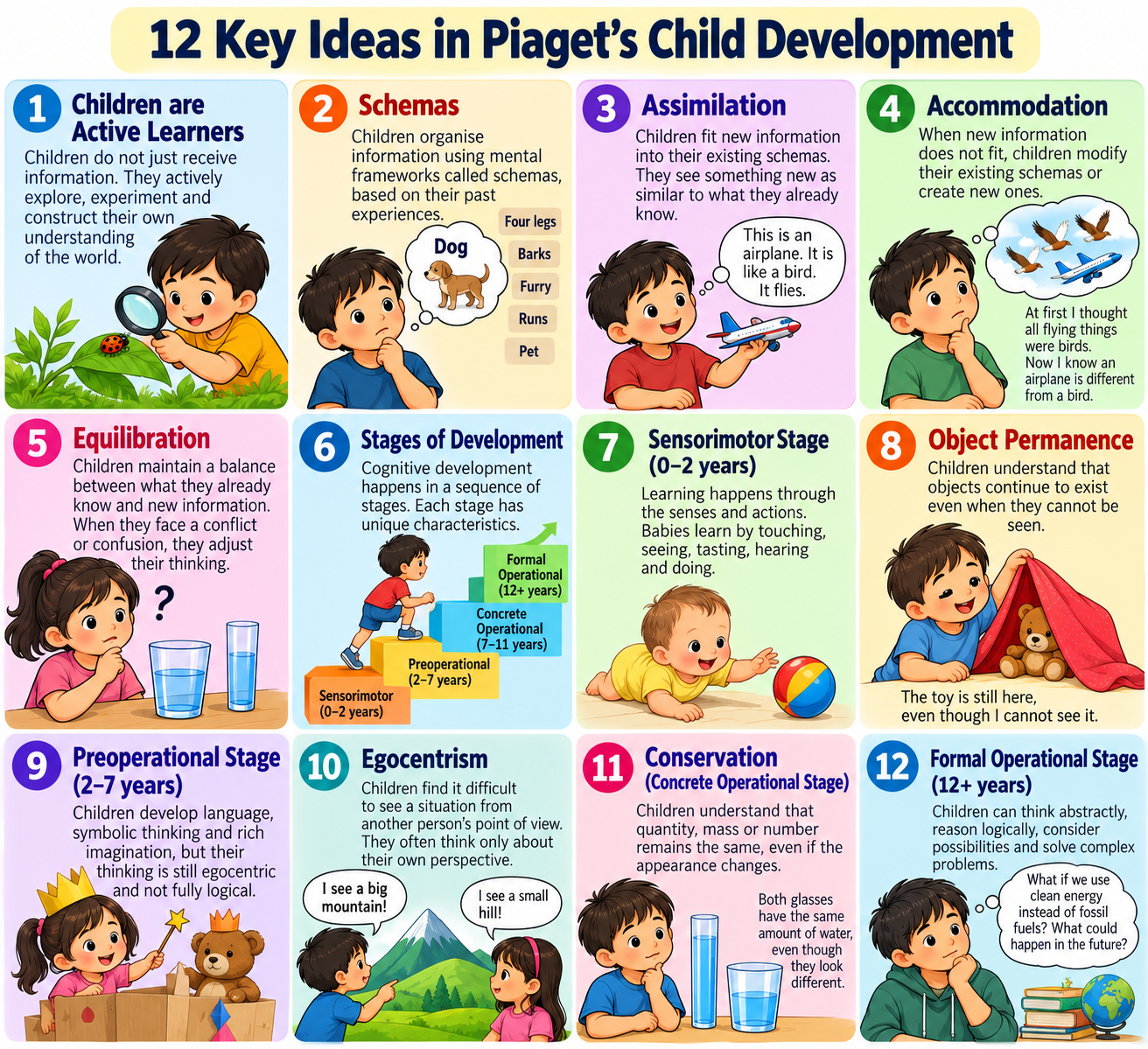
Piaget also proposed four broad stages of cognitive development: sensorimotor, preoperational, concrete operational and formal operational. These stages influenced educational discussions about developmental readiness, concrete experiences and the gradual development of abstract reasoning.
Later research has qualified aspects of his stage theory, particularly the idea that children move through fixed, universal stages at precisely defined ages. Nevertheless, his central contribution remains important: teaching must take account of how learners understand, not merely what they are expected to know.
The debate that changed educational thinking
The shift from behaviourism to Piaget was not a battle in which one theory replaced another. It was an expansion of our understanding of learning. Behaviourists focused on observable performance, practice and reinforcement; Piaget explored how children construct knowledge and develop understanding. John Dewey emphasised learning through experience, Lev Vygotsky highlighted social interaction and guided learning, Jerome Bruner championed discovery, and David Ausubel stressed the importance of prior knowledge.
Consider a Class V mathematics lesson on fractions. A teacher following a conventional approach might explain the rules, ask students to memorise them and give exercises for practice. A Piaget-inspired approach might begin by asking children to divide a paper circle into equal parts, compare one-half with two-quarters and explain why they represent the same quantity. The teacher observes their reasoning, identifies misconceptions and guides them towards the mathematical principle. Both approaches involve teaching and practice, but the second makes children’s thinking an essential part of the learning process.
Together, these thinkers helped move educational thinking beyond correct answers towards deeper understanding, reasoning and independent thought. Practice and reinforcement remain valuable, but learning is not merely about producing the right response; it is about understanding why it is right.
The significance of Piaget’s legacy is therefore not that schools have abandoned older methods. Rather, education now has a stronger intellectual basis for questioning whether those methods, on their own, are sufficient.
From theory to the Indian classroom: an unfinished transition
The influence of these ideas can be seen in activity-based learning, experiments, educational games, projects, inquiry-based teaching and formative assessment. In mathematics, children can work with objects and visual representations before moving to abstract symbols. In science, they can make predictions, conduct experiments and explain their observations. In environmental studies, they can investigate local problems rather than simply memorise textbook descriptions.
Assessment can also go beyond checking whether an answer is correct. Asking a student to explain how a conclusion was reached often reveals misconceptions that a written test alone may miss.
In India, the National Education Policy 2020 and the National Curriculum Framework for School Education emphasise conceptual understanding, critical thinking, competency-based learning and learning through experience. These priorities reflect important aspects of Piaget’s thinking, alongside insights from other educational traditions and contemporary research.
Yet the transition from policy to practice remains unfinished.
A teacher may be encouraged to promote inquiry and independent thinking but face a large class, a demanding syllabus, limited resources and examinations that reward the reproduction of prescribed answers. Under such conditions, explanation, dictation and repetition can become the easier choices. Educational practice is shaped not only by theory but also by teacher preparation, parental expectations, administrative requirements and the pressure to complete the syllabus.
This creates a contradiction at the heart of schooling. We ask children to think independently, yet often assess them on how accurately they reproduce what they have been taught.
The answer is not to abandon examinations or dismiss the value of structured teaching. It is to broaden our understanding of evidence of learning. Written tests can be complemented by practical work, projects, oral explanations and tasks that require students to apply knowledge in unfamiliar situations.
The real measure of reform is not whether a policy uses the language of critical thinking. It is whether a child gets the opportunity to ask a question, test an idea, make a mistake and arrive at an understanding of their own.
Learning in the Age of AI
Generative artificial intelligence has changed how students access knowledge. They can now ask an AI system to explain photosynthesis, solve a mathematical problem, summarise a chapter or help write an essay. Explanations can be simplified, translated and adapted to individual needs.
The opportunity is enormous, but so is the challenge. A student may produce a correct answer without understanding it, or submit a polished essay without developing the ideas independently. The appearance of learning can easily be mistaken for learning itself.
Piaget could not have anticipated today’s AI systems, but his central insight remains relevant: learning involves actively constructing and revising our understanding. Receiving an answer is not the same as understanding it.
Imagine a Class VII student investigating why some objects float while others sink. The student predicts what will happen to a stone, a piece of wood and a sealed plastic bottle placed in water. After testing the objects, the student compares the results with the predictions and develops an initial explanation.
AI can then help explain density, buoyancy and displacement. The teacher can ask the student to check these explanations against the observations and describe the concept independently.
AI has now become a resource for learning, not a substitute for it.
The same principle applies to writing, mathematics, history and other subjects. Students can use AI to explore ideas, compare interpretations and receive feedback. But they must also learn to question its answers, evaluate evidence and recognise errors.
The real test is not whether a student can obtain an answer, but whether the student can explain, question and use it intelligently.
The Teacher and the Purpose of Education
If AI can explain almost anything in seconds, what remains distinctive about teaching?
Quite a lot. Teaching involves recognising misconceptions, asking the right questions, encouraging struggling learners and creating opportunities for discussion and discovery. It also requires sensitivity to the social and emotional circumstances in which children learn.
Piaget reminds us that learning depends on the development of understanding. Vygotsky highlights the role of social interaction and appropriate guidance. Together with contemporary research on memory, motivation and effective instruction, these perspectives remind us that education is far more than the delivery of information.
The teacher’s role, therefore, is not to compete with a machine in producing answers. It is to design experiences that help children think independently, make connections, learn from mistakes and exercise sound judgement.
This brings us to a fundamental question: when a machine can explain almost anything, are we giving children enough opportunities to discover, reason and develop ideas of their own?
The future of education will depend not simply on how much technology enters our classrooms, but on how wisely we use it.
If machines become better at producing answers, education must become better at developing minds.
That is the enduring relevance of Piaget in the age of artificial intelligence.
.
My next article will explore Lev Vygotsky’s fascinating insights into the social nature of learning and how his work extended Piaget’s ideas by highlighting the crucial role of social interaction, language and culture in a child’s cognitive development.