
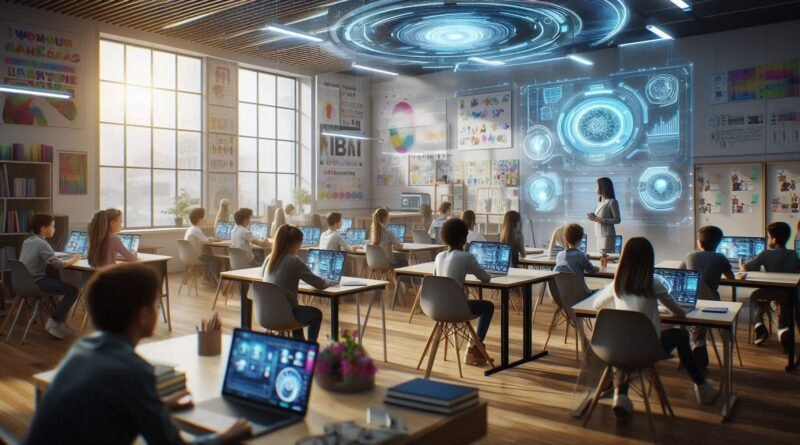
CBSE’s AI-friendly syllabus: Beyond Blackboards
CBSE’s new AI-friendly syllabus signals a shift beyond rote learning and blackboards. Explore how NEP 2020 and NCF 2023 are reshaping classrooms with skills, technology, and critical thinking..
🌱 A Shift That Goes Beyond Chalk and Talk
For decades, Indian classrooms have been defined by blackboards, textbooks, and memorization. But that image is rapidly evolving. CBSE’s emerging curriculum—aligned with NEP 2020 and NCF 2023—signals a decisive move toward an AI-aware, skills-driven education system.
This is not about replacing teachers with technology; it is about redefining how learning happens.
🤖 From Rote Learning to Intelligent Learning
The traditional model rewarded memory. The new approach rewards understanding, application, and creativity.
CBSE has begun integrating:
- Artificial Intelligence as a subject (from middle grades)
- Coding and computational thinking
- Data literacy and problem-solving
Students are no longer just learners—they are becoming creators and thinkers.
📘 The NEP 2020 Foundation
At the heart of this transformation lies NEP 2020, which envisions education as multidisciplinary, flexible, and future-ready.
👉 https://www.education.gov.in/sites/upload_files/mhrd/files/nep/NEP_Final_English.pdf
The policy clearly emphasizes:
- Experiential learning over memorization
- Digital literacy as a core competency
- Integration of technology across subjects
This is where AI enters—not as a separate tool, but as a learning ecosystem.
📚 NCF 2023: Turning Vision into Practice
The National Curriculum Framework (NCF) 2023 operationalizes this vision.
👉 https://ncert.nic.in/pdf/NCF-SE-2023.pdf
It introduces:
- Activity-based learning
- Project-driven assessments
- Interdisciplinary connections
Instead of asking “What is the answer?”, classrooms now ask “How did you arrive at it?”
🎓 What Changes for Students
Students will experience learning very differently:
- Less dependence on textbooks
- More real-world problem solving
- Exposure to AI tools, coding platforms, and simulations
👉 https://cbseacademic.nic.in/curriculum_2027.html
Exams, too, are gradually shifting toward competency-based questions, testing understanding rather than recall.
🏫 What Schools Must Adapt To
Schools are no longer just teaching centers—they are becoming learning ecosystems.
They must now:
- Train teachers in digital and AI tools
- Upgrade infrastructure (smart classrooms, labs)
- Encourage innovation and experimentation
The role of the teacher evolves from “information provider” to learning facilitator.
👨👩👧 What Parents Should Notice
For parents, this shift may feel unfamiliar—but it is necessary.
The future workplace will demand:
- Critical thinking
- Adaptability
- Technological fluency
Encouraging curiosity, allowing children to explore, and moving away from marks obsession will be key.
🌍 Education for the AI Age
AI is not just another subject—it is shaping how we live, work, and think.
CBSE’s new direction ensures that students are not passive consumers of technology, but responsible and creative participants in an AI-driven world.
🚀 A Classroom Reimagined
The blackboard is not disappearing—but its dominance is.
In its place emerges a classroom where:
- Questions matter more than answers
- Exploration matters more than memorization
- Understanding matters more than marks
CBSE’s AI-friendly syllabus is not just a reform—it is a reimagination of education itself.