
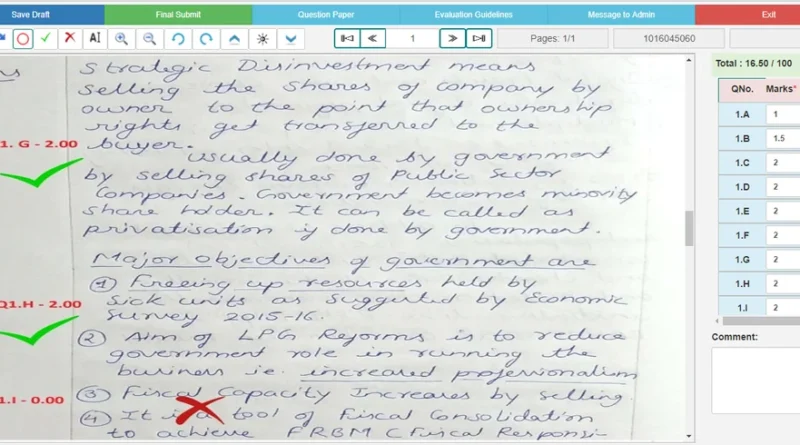
CBSE’s Growing Administrative Crisis: Questions Raised Over OSM Portal Management
Questions are being raised over the development of Central Board of Secondary Education’s OSM portal, alleged vendor links, and the involvement of Indian Institute of Technology Madras amid concerns about governance and examination administration.Fresh questions have emerged regarding the development and management of the OSM portal associated with Central Board of Secondary Education, with reports highlighting alleged links involving external vendors and references to Indian Institute of Technology Madras.
The controversy has intensified wider discussions regarding administrative oversight, digital governance, procurement transparency, and technological accountability within India’s largest school education board.
The matter has attracted attention from educators, students, parents, and policy observers due to the scale and importance of CBSE’s examination and digital infrastructure systems.
Questions Around Portal Development
According to reports and ongoing public discussion, concerns have been raised regarding:
- The entity responsible for building and operating the OSM portal
- The nature of vendor engagement and outsourcing arrangements
- Oversight and accountability mechanisms
- Technical management and security processes
- Institutional coordination involving academic and technology partners
The references to Indian Institute of Technology Madras in connection with aspects of the portal have reportedly led to additional public curiosity regarding the exact extent and nature of institutional involvement.
No formal allegations of wrongdoing against IIT Madras have been conclusively established in publicly available information at this stage.
Digital Governance Under Spotlight
The controversy reflects broader concerns regarding digital governance in large public examination systems.
Central Board of Secondary Education oversees millions of students across India and internationally, making its digital systems critically important for:
- Examination management
- Student records
- Assessment processes
- School coordination
- Result processing
- Administrative communication
Experts note that any confusion or lack of transparency involving digital infrastructure can significantly affect public confidence.
Challenges of Large-Scale Education Technology Systems
Education technology systems operating at national scale face major operational challenges including:
- Cybersecurity
- Data privacy
- Vendor management
- Infrastructure reliability
- Scalability during peak traffic
- Technical accountability
As examination systems become increasingly digital, boards and universities are relying more heavily on private technology vendors, software platforms, and institutional collaborations.
Experts argue that such partnerships require strong governance frameworks and transparent procurement processes.
Public Concern Over Transparency
Observers have pointed out that public educational institutions managing sensitive student and examination data must maintain high standards of transparency regarding:
- Technology procurement
- Vendor selection
- Data management policies
- Institutional partnerships
- Security protocols
Education policy analysts believe transparency becomes especially important when systems impact millions of students and families nationwide.
IIT Madras and Technology Collaborations
Indian Institute of Technology Madras is widely known for research, innovation, and technological collaboration initiatives across education and industry sectors.
India’s premier technical institutions often participate in advisory, research, or collaborative technology projects with government agencies and educational bodies.
However, experts caution that institutional association in technical projects may vary widely in scope — ranging from consultation and research support to independent project participation.
The precise nature of any involvement connected to the OSM portal would therefore require official clarification rather than speculation.
Administrative Pressure on CBSE
The latest controversy comes at a time when Central Board of Secondary Education is already managing increasing administrative complexity because of:
- Massive student enrolment growth
- Examination reforms
- Digital transformation initiatives
- Competitive academic pressures
- National Education Policy implementation
- Expansion of online systems
Education experts note that maintaining operational efficiency at such scale is an enormous institutional challenge.
“CBSE’s Holy Mess” Debate
The phrase “CBSE’s holy mess,” increasingly circulating in commentary and online discussions, reflects broader frustration among some stakeholders regarding recurring issues linked to:
- Examination administration
- Digital platform performance
- Policy communication
- Coordination challenges
- Administrative decision-making
However, education experts also caution against oversimplifying the functioning of one of the world’s largest school boards, which manages extremely complex operations involving thousands of schools and millions of learners.
Need for Institutional Clarity
Experts believe the current situation highlights the importance of:
- Clear official communication
- Transparent technology governance
- Independent technical audits
- Defined accountability mechanisms
- Public disclosure regarding procurement and partnerships
They argue that educational institutions increasingly require sophisticated digital governance frameworks comparable to those used in banking, finance, and critical public infrastructure sectors.
Broader Debate on Education Technology Governance
The controversy has also reignited wider debate regarding the rapid expansion of educational technology systems in India.
Questions increasingly being discussed include:
- Who owns educational data?
- How are vendors selected?
- What safeguards protect student information?
- How should accountability be enforced?
- What level of public transparency is appropriate?
As digital platforms become central to education administration, governance standards are expected to receive greater scrutiny.
Awaiting Official Clarification
At present, many stakeholders are awaiting detailed clarification from Central Board of Secondary Education and other concerned institutions regarding the development, management, and oversight structure of the OSM portal.
The episode has once again highlighted the growing importance of transparency, digital accountability, and institutional trust in India’s rapidly evolving education system.