
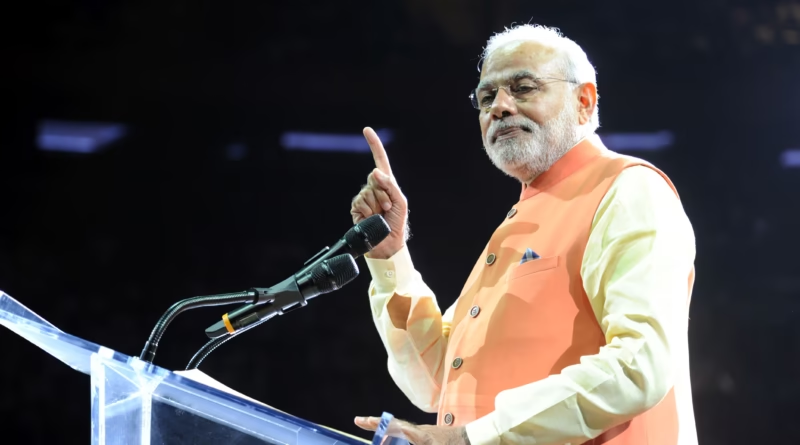
PM Modi to Lead NITI Aayog Review of Education Reforms on June 11
PM Modi, NITI Aayog meeting June 11, education reforms India, NEP 2020 implementation, school education reforms, higher education policy, skill development India, learning outcomes, education governance, NITI Aayog education agenda, Prime Minister Narendra Modi, Indian education system, education policy India, academic reforms, education sector updates.New Delhi: Prime Minister Narendra Modi is set to chair an important meeting of the Governing Council of NITI Aayog on June 11, where education reforms are expected to feature prominently on the agenda. The meeting comes at a time when both the Centre and states are working to accelerate the implementation of the National Education Policy (NEP) 2020 and address persistent challenges in school and higher education.
The annual Governing Council meeting, which brings together chief ministers, lieutenant governors, Union ministers, and senior policymakers, serves as a crucial platform for cooperative federalism and policy coordination. Discussions this year are likely to focus on improving learning outcomes, strengthening foundational literacy and numeracy, expanding digital education infrastructure, and enhancing employability through skill-based learning.
Education has emerged as one of the key pillars of India’s development strategy as the country seeks to leverage its demographic dividend. With nearly 250 million school-going children and one of the largest higher education systems in the world, policymakers face the challenge of ensuring both access and quality. The June 11 meeting is expected to review progress made under various initiatives launched since the introduction of NEP 2020 and identify areas requiring greater attention.
A major focus is likely to be the implementation of foundational learning programmes. Educational experts have repeatedly highlighted concerns regarding learning levels among students, particularly in the early grades. The government’s flagship NIPUN Bharat Mission aims to ensure that every child attains foundational literacy and numeracy by the end of Grade 3. The NITI Aayog meeting may assess the effectiveness of state-level interventions and explore strategies to bridge learning gaps that widened during the pandemic years.
The adoption of the National Education Policy remains another important issue. The policy envisions a comprehensive transformation of India’s education system through multidisciplinary learning, flexibility in subject choices, vocational integration, and a shift away from rote learning. While several states have initiated reforms aligned with the policy, implementation levels vary significantly across the country. The meeting is expected to encourage greater collaboration between states and the Centre to achieve the policy’s long-term objectives.
School education reforms are also likely to receive considerable attention. Recent changes introduced by the Central Board of Secondary Education (CBSE), including competency-based assessments and revised curriculum frameworks, reflect a broader move toward conceptual understanding and skill development. Policymakers may discuss how similar reforms can be effectively implemented across different state education boards while maintaining educational standards and equity.
Higher education is another area expected to be reviewed. Over the past few years, the government has introduced several initiatives aimed at improving research, innovation, and institutional quality. Universities and colleges are increasingly being encouraged to adopt multidisciplinary structures, establish academic credit banks, and provide greater flexibility to students. The meeting may examine the progress of these initiatives and identify ways to strengthen research ecosystems, particularly in emerging fields such as artificial intelligence, quantum technologies, and biotechnology.
Skill development and employability are likely to feature prominently in the discussions. Industry leaders have frequently pointed out the need to align educational outcomes with labour market requirements. Policymakers are expected to deliberate on measures to enhance vocational education, apprenticeship opportunities, and industry-academia collaboration. Integrating practical skills into mainstream education has been one of the central objectives of NEP 2020, and the NITI Aayog forum offers an opportunity to review progress in this area.
Digital education infrastructure is expected to be another key topic. The rapid adoption of online learning tools during and after the COVID-19 pandemic highlighted both opportunities and challenges within the education system. While digital platforms have expanded access to learning resources, disparities in internet connectivity and device availability continue to affect many students, particularly in rural and underserved regions. The meeting may explore ways to strengthen digital infrastructure and ensure equitable access to technology-enabled education.
The role of states in driving educational transformation is expected to be a recurring theme throughout the discussions. Since education falls within the Concurrent List of the Constitution, effective implementation of reforms requires close cooperation between the Centre and state governments. The Governing Council meeting provides an important forum for sharing best practices, identifying common challenges, and developing coordinated solutions.
Observers believe that the outcomes of the June 11 meeting could influence the direction of educational policymaking in the coming years. As India seeks to become a knowledge-driven economy and achieve its long-term development goals, the quality of its education system will remain a decisive factor.
With Prime Minister Modi chairing the discussions, stakeholders across the education sector will be closely watching the meeting for signals regarding future reforms, funding priorities, and implementation strategies. The deliberations are expected to reinforce the government’s commitment to building an education system that is more inclusive, flexible, skill-oriented, and aligned with the needs of the twenty-first century.